
American Chestnut, or the American Sweet Chestnut (Castanea dentata) was formerly among the Long Point Basin’s largest tree species – the largest historical specimens measured around 55 m tall, with girths in excess of 2 m, a earning it the name “Redwood of the East”, along with the Tuliptree (Liriodendron tulpifera), and Eastern White Pine (Pinus strobus). It is a member of the Beech Family, Fagaceae, along with American Beech (Fagus grandifolia), of which it shares many morphological characteristics, and oaks, which is a sister genus to both sweet chestnuts, Castanea, and the Castanopsis genus of east Asia, a large group of subtropical and warm temperate tree species. In Ontario, American Chestnuts are most often observed within the Long Point Basin, and the Skunk’s Misery area of southwest Middlesex County, though they can be found from Windsor to Hamilton.

Chestnut Blight
Unfortunately, American Chestnut was brought to functional extinction in most areas due to the introduction of the Chestnut Blight (Cryphonectria parasitica) from Japan. It was first introduced to the Bronx Zoo in New York City on imported Japanese Chestnuts (Castanea crenatae). The blight spread rapidly across Eastern North America, decimating 40 million American Chestnut Trees. It remains the most severe pathogen faced by any tree, with a >99% aboveground mortality rate. The roots are unaffected by Chestnut Blight, so the tree sends up suckers – these small specimens are the form of American Chestnut most readily encountered across North America today. Recent research has unveiled that trees in Ontario, at the northern edge of American Chestnut’s geographical distribution, are slightly more resistant to Chestnut Blight than American Chestnut trees south of the border, allowing for more remnant large trees to be encountered. There are also large trees outside American Chestnut’s native range, such as in Northern Michigan and Wisconsin – in these areas, less virulent strains of Chestnut Blight are dominant. European Sweet Chestnuts (Castanea sativa) also were impacted by Chestnut Blight, but have largely survived as a forest tree due to the successful introduction of hypervirulent (diseased) strains of blight, which inflict less damage than the strongly virulent strains of blight found in North America. Japanese Chestnuts and Chinese Chestnuts (Castanea mollissima) are extremely resistant to the chestnut blight – the main commercial chestnut species today.
For context, Chestnut Blight is at least tenfold more severe than Emerald Ash Borer (Agrilus planipennis) and Dutch Elm Disease (Ophiostoma novo-ulmi) – the latter hosts (Ash, Fraxinus sp., and Elm, Ulmus sp.) still have a large presence on the landscape, but are heavily impacted by their respective diseases. Not so coincidentally, these forest pests and diseases are also from the Japan, and the same holds true for Butternut Canker (Ophiognomonia clavigignenti-juglandacearum), Dogwood Anthracnose (Discula destructiva), Beech Leaf Disease (Litylenchus crenatae mccannii nematodes), and Hemlock Adelgid (Adelges tsugae). The reason why so many forest diseases originate in Japan and nearby areas is due to the extremely similar ecological conditions found in that area – boosting similar vegetation communities and species assemblages (i.e., beech forests) in both the canopy and understory. This is especially true of northern Honshu and Hokkaido. Thus when a pathogen of one region is transferred to the other – it has the potential to wreak havoc. Northeast Asian forests are currently being impacted by the Eastern North American Pine Nematode, killing many Japanese Red Pines (Pinus densiflora), Japanese Black Pines (Pinus thunbergii), and Korean Pines (Pinus koraiensis), whereas our native White Pine (Pinus strobus), Red Pine (Pinus resinosa), and Jack Pine (Pinus banksiana) are (as expected), almost completely resistant!
Description
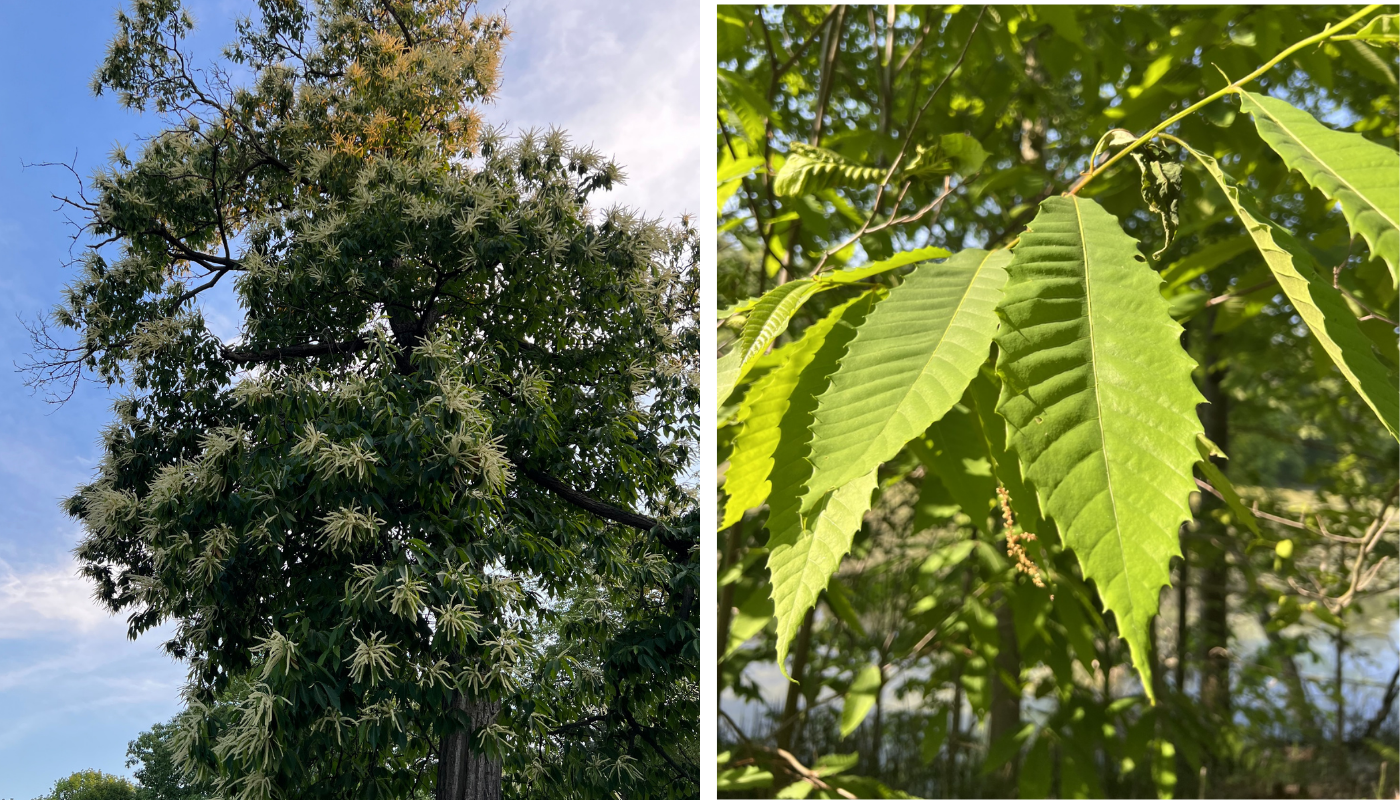
American Chestnut, historically, was mostly encountered as large deciduous tree. The leaves were alternately arranged, each typically measuring between 15 to 30 cm long and 7-10 cm wide, with hooked teeth on the leaf margins, giving American Chestnut it’s species name dentata, which means toothed. The leaves can be confused with those of beech, but chestnut leaves are usually much longer. The bark consists of broad, flat ridges with fissures, exposing the reddish bark. This is quite similar to Northern Red Oak (Quercus rubra), though Red Oak bark has vertical streaking which is light grey or white in colour. The buds are triangular, smoothened and yellow, unlike American Beech, which has elongated buds with overlapping scales. The creamy white flowers appear very late for a native hardwood – typically in July, and are quite showy. The male flowers are stiff, catkin-like structures, 12-20 cm long. In the southern Appalachians of North Carolina and eastern Tennessee, the region that Chestnuts were formerly most abundant – the display flowers were described as “turning hillsides white”. The female flowers are much smaller, situated near the base of short catkins 4-6 cm long, and when pollinated, fruit develops which contain chestnuts. Both male and female flowers occur on the same tree, but like most Fagaceae species, two different trees are needed for successful pollination. This makes it substantially more difficult for plant breeders to develop a blight resistant tree. The fruit, which is a spiny burr measuring 5-11 cm, matures in September or October. Each burr contains 1-5 edible nuts.
Historically, American Chestnut was a dominant species within many forest types. It reaches it’s highest abundances in well-drained, acidic upland forests, most often growing alongside Red Oak, White Oak (Quercus alba), Black Oak (Quercus velutina), Red Maple (Acer rubrum), Sassafras (Sassafras albidum), hickories (Carya sp.), Black Cherry (Prunus serotina), White Pine (Pinus strobus). It has an affinity for sandy soils, making much of the Long Point Basin ideal habitat for the species. It can also grow in mesophytic forests, at lower densities with Sugar Maple (Acer saccharum), American Beech, White Ash (Fraxinus americana) and Tuliptree (Liriodendron tulipifera). However, it is much more common in Oak-Pine-Red Maple forests as compared to Sugar Maple-Beech forests, since the latter forest type contains mesophytes highly competitive in fully shaded conditions, which can outcompete American Chestnut, whereas the Oak-Pine-Red Maple forests have less intense competition for light, allowing American Chestnut to become dominant in many of these strands. American Chestnut is quite intolerant of wet conditions – so it is scarce or absent in both swamps and floodplains. It can grow inside oak woodland savannas, but usually only of secondary importance compared to the more dominance compared to oaks.
Wildlife importance
Prior to the blight, the American Chestnut was an unparalleled food source for a vast array of wildlife. Its nuts were highly nutritious, sweet, and produced in abundant, reliable annual crops – unlike the high variations in fruit production observed in oaks and beeches, an evolutionary adaptation against predators, especially nut weevils (Curculio sp.), which larvae consume the nut. These chestnuts were an important autumn food source for numerous species, including Wild Turkey (Meleagris gallopavo), White-tailed Deer (Odocoileus virginianus), Squirrels (Sciuridae), Chipmunks (Tamias spp.), Blue Jays (Cyanocitta cristata), and Black Bears (Ursus americanus), allowing the latter species to fatten up for winter hibernation. They were also consumed en masse by the extinct Passenger Pigeon (Ectopistes migratorius), formerly the most numerous wild bird species in the world. The functional extinction of the American Chestnut led to sharp declines in insects reliant on the trees, so much so that ecologists classified a few species of chestnut moths (such as Coleophora leucochrysella and Zimmermannia bosquella) extinct for many years, until their rediscovery in the 2020s via citizen science platforms like iNaturalist. Weevils consuming Chesnuts include Curculio caryatrypes and Curculio sayi, also extant, despite the loss of it’s primary host tree.
Attempted restoration efforts
Since it’s decimation by the Chestnut Blight, ecologists, landowners, and plant breeders have attempted to develop a blight-resistant tree. In Ontario, the Canadian Chestnut Council has been working on developing a blight-resistant American Chestnut Tree by concentrating genes conferring for blight resistance. They have been using a variety of experimental approaches, such as cross breeding American and Asian Chestnuts to create blight-tolerant hybrids, and breeding pure American Chestnuts, a small number which possess blight resistance. This breeding program has established for almost 30 years. The Canadian Chestnut Council has been more focused on breeding pure American Chestnut trees, in contrast with American agencies, which more utilize hybrid chestnuts (and even a controversial genetically engineered chestnut, recently shelved in 2024 due to it’s defectiveness against the blight). Currently, the Canadian Chestnut Council establishing it’s F3 generation, which should have more blight resistance than the previous F2 generation. In a few years, the F4 generation will be selected most blight-resistant F3 American Chestnuts, further concentrating blight resistance. Time will tell when a blight resistant tree will become sufficiently common for use in large-scale restoration programs.
Members of Long Point Basin Land Trust have been involved with the Canadian Chestnut Council’s current restoration efforts. These include breaking isolation projects, where several chestnut saplings are planted in close vicinity to a remnant, blight-resistant American Chestnut, and general tree planting on some of Long Point Basin’s nature reserves.
Fun facts
- American chestnuts are notably sweeter than European or Chinese chestnuts, a characteristic that was prized for eating fresh, roasted, or in desserts. This sweetness is due to a higher sugar content and lower starch content compared to other chestnut species.
- In some older forests, even today, ghost-like stump remains of massive American Chestnut logs can be found on the forest floor – remarkably resistant to decay.
- American Chestnuts were long-lived trees, with individuals estimated to live for 400 years or more. This longevity allowed them to become truly massive and dominant features of the forest canopy.
- American Chestnut is one of three species of Chestnuts in North America, along with the Ozark Chinquapin (Castanea ozarkensis), a small or medium-sized tree found in the Ozarks of Missouri to Arkansas, and the Allegheny Chinquapin (Castanea pumila), a shrub or small tree of the southeastern United States (despite it’s name, not found in the Allegheny Plateau of NW Pennsylvania).
Written by Matthew Palarchio, HBSc in Environmental Sciences, Western University
All photos are provided by Matthew Palarchio
The species you’ve just read about—and the ecosystems they depend on—need our protection. Support the work of the Long Point Basin Land Trust and help preserve the wild spaces of the Long Point Basin: https://longpointlandtrust.ca/donate
To view a directory of all species featured on our website, visit: https://longpointlandtrust.ca/featured-species

