
Description and ecology
The American Robin (Turdus migratorius) is a large migratory songbird (25 cm long). It is a member of the True Thrush Family, Turdidae. Unlike the Wood Thrush, American Robin is not in a monospecific genus – it is part of a large worldwide genus of over 100 species, the most biodiverse of the entire Thrush Family. They are unrelated to the European Robin (Erithacus rubecula) – an Old-World (Eurasian) Flycatcher. Instead, the equivalent niche of American Robin is largely filled by the European Blackbird (Turdus merula). In North America, this species is very widely distributed – found almost anywhere north of Mexico (though a few subspecies occur in the Mexican Cordilleras).
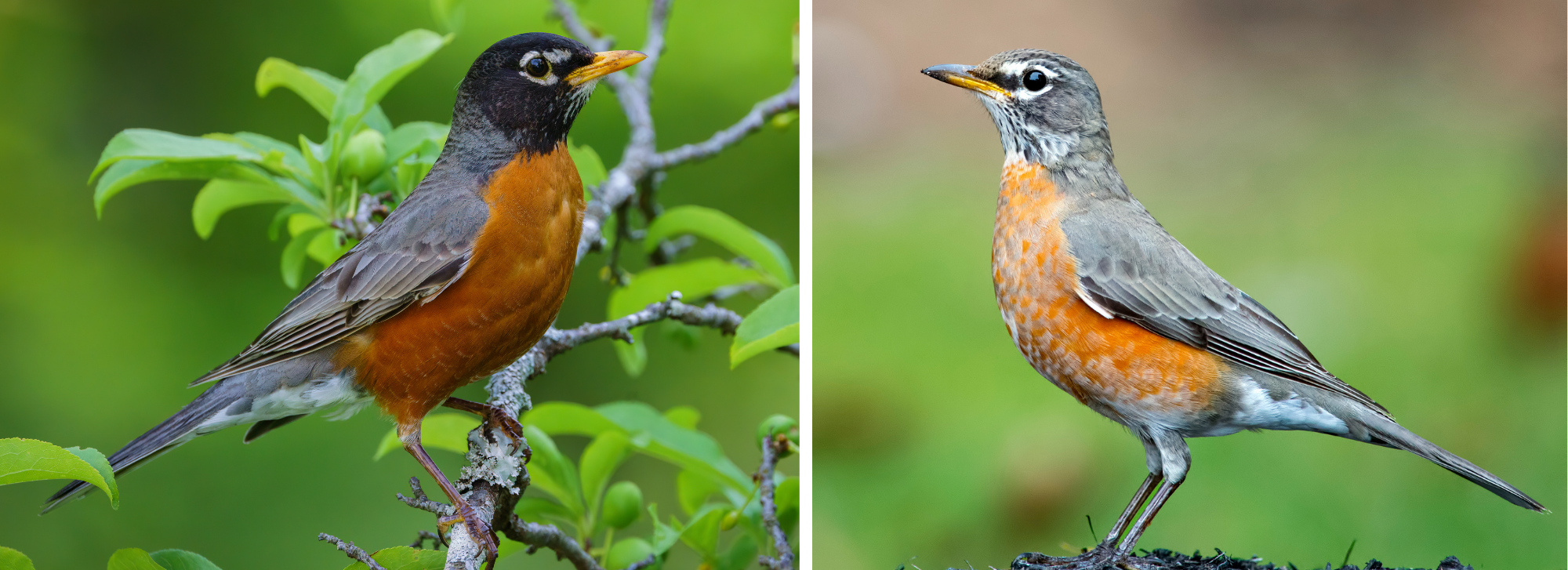
While American Robins can be observed throughout the year, they are most often observed in the spring, in April and May, which corresponds with their breeding season. Both sexes American Robin are rusty orange on the underside and blackish blue above. Male robins are more vibrant orange than female robins, which have more of a tan colour on the underside. Robins also have white eye-rings and had a yellow bills. In late winter, male American Robins travel to their breeding grounds to establish a breeding territory. Their song, described by the mnemonic “cheer-up, cheerily, cheer-up, cheerily”, is a sure sign of spring’s arrival across the Great Lakes Region, beginning as early as 4:00 am. Like other songbirds, these are males. In late July, the is a noticeable decline in the song of Robins – and throughout late summer they sing only scarcely, mostly vocalizing chirping through singing in the understory. Many robins migrate to the southern United States around the end of September to spend winter, but some remain in the Great Lakes Region throughout the colder months. They are much more likely to be found in flocks during autumn and winter than during the breeding season.
A female American Robin will lay 3-5 turquoise eggs. The incubation period is 13 days, subsequently, the nestling raising period is another 13 days. Over the summer breeding season, American Robins produce 2-3 broods, with the last one usually fledged by the end of July. The female American Robin is the primary incubator of the eggs – she has a specialized brood patch on her belly to help transfer the body heat to eggs more efficiently. During that time – male American Robins are singing loudly, helping to defend their territory from possible competitors and predators.
American Robins feed on a wide variety of arthropods, and annelids (worms) – . In urban areas, they are often observed feeding on earthworms during the breeding season. In addition to their insectivores. Although primarily a ground forager – American Robins have also been observed feeding from trees. From July onwards, American Robins become heavily frugivorous as well, consuming a large diversity of fleshy fruits, including cherries (Prunus sp.), hawberries (Crataegus sp.), dogwood berries (Cornus sp.), viburnum (Viburnum sp.), serviceberries and saskatoon-berries (Amelanchier sp.), raspberries and blackberries (Rubus sp.), currants (Ribes sp.), chokeberries (Aronia sp.), sumac berries (Rhus sp.), and honeysuckle (Lonicera sp.). Like many other songbirds, they are immune to Poison-Ivy (Toxicodendron sp.), being able to consume these fruits en masse as they mature.
American Robins have a large population – some authorities estimated over 300 million birds in North America, making it one of the most abundant North American songbird species, with more individual than even Red-winged Blackbirds (Agelaius phoeniceus). They are truly a ubiquitous songbird throughout Great Lakes Region, found in almost any habitat – savannas, forests, swamps, meadows, and shrublands.
Written by Matthew Palarchio, HBSc in Environmental Sciences, Western University
All photos are Stock photos retrieved from Canva
The species you’ve just read about—and the ecosystems they depend on—need our protection. Support the work of the Long Point Basin Land Trust and help preserve the wild spaces of the Long Point Basin: https://longpointlandtrust.ca/donate
To view a directory of all species featured on our website, visit: https://longpointlandtrust.ca/featured-species

