
Description and Ecology
The Brown Thrasher (Toxostoma rufum) is a long-tailed, ground-foraging songbird in the Mimic Thrush (Mimidae family), which is exclusively American. Northern Mockingbirds (Mimus polyglottos) and Gray Catbirds (Dumetella carolinensis) are the other native species in this bird family occurring in the Great Lakes Region. It is the only Toxostoma species commonly found in the eastern North America, with most other thrasher species occurring in arid desert regions of southwestern United States and northern Mexico. In the Great Lakes Region, the Brown Thrasher is a familiar summer breeding resident, known for its secretive behavior and exuberant song. The Brown Thrasher is distributed from southwestern Ontario south to Florida, west to Texas and Alberta. It is a year-round species in the southern United States.
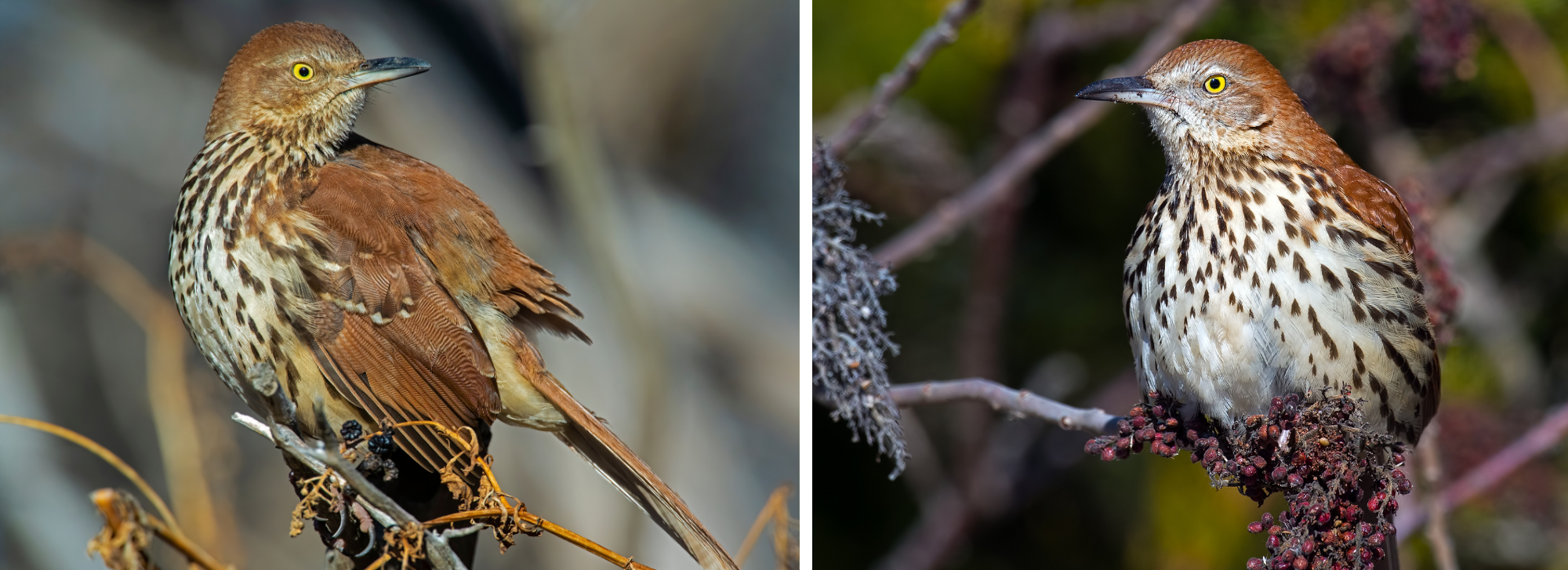
Brown Thrashers inhabit shrublands and open forests, often preferring areas with low understory for nesting and foraging. Thrashers are often detected by their rich, and varied song—a long series of musical phrases, many of which are repeated in pairs, a hallmark trait of mimid family members. Male Brown Thrashers mock the songs of other species – including the Northern Cardinal (Cardinalis cardinalis), American Robin (Turdus migratorius), Blue Jay (Cyanocitta cristata), Eastern Towhee (Pipilo erythrophthalmus), Tufted Titmouse (Baeolophus bicolor), Northern Flicker (Colaptes auratus), Wood Thrush (Hylocichla mustelina), Carolina Wren (Thryothorus ludovicianus), Red-eyed Vireo (Vireo olivaceus), White-eyed Vireo (Vireo griseus), Song Sparrow (Melospiza melodia), Chipping Sparrow (Spizella passerina), Field Sparrow (Spizella pusilla), Brown-headed Cowbird (Molothrus ater), Killdeer (Charadrius vociferus), Great Crested Flycatcher (Myiarchus crinitus), Yellow Warbler (Setophaga petechia), Common Yellowthroat (Geothlypis trichas), Indigo Bunting (Passerina cyanea), House Wren (Troglodytes aedon), Gray Catbird (Dumetella carolinensis), and Northern Mockingbird (Mimus polyglottos). Some male Brown Thrashers can sing over 1,000 song types – most vocal in April and May, when they are establishing a breeding territory and attracting a female. Thrashers are generally monogamous within the breeding season.
Each summer, Brown Thrashers typically raise 1 brood in the Great Lakes Region (2 broods is common in the southeastern United States, where summers are much longer). The female builds a bulky cup nest, usually in dense shrubbery or low trees. Nests are constructed from twigs, grasses, and rootlets, and are well hidden. The female lays 3–5 eggs per clutch, which are pale blue to greenish with reddish-brown speckles. Incubation lasts 11–14 days, and both parents feed the nestlings until they fledge after 9–13 days.
Brown Thrashers are omnivorous, feeding primarily on insects and other invertebrates during the summer breeding season. Their diet includes beetles (Coleoptera), caterpillars and moths (Lepidoptera), grasshoppers (Orthoptera), ants, wasps, and bees (Hymenoptera), spiders (Araneae), and snails. Foraging is done mostly on the ground, where they use their long, curved bills to sweep aside leaf litter in search of prey. Starting in late summer and winter, they also consume a wide variety of fruit, including dogwood berries (Cornus sp.), blackberries (Rubus sp.), sumac fruits (Rhus sp.), elderberries (Sambucus sp.), cherries (Prunus sp.), and grapes (Vitis sp.), as well as acorns (from Quercus sp., especially White Oak, Quercus alba) and cultivated fruit when available.
The Brown Thrasher population is generally considered stable, although it has experienced some decline, through ecological succession to dense forests, agricultural intensification, or urban development – all which result in the loss of shrubland and open forest habitat. It remains a fairly common breeding bird across much of its range and is often one of the first large songbirds to return to northern areas in early spring. In Norfolk County, it has likely benefitted from the activities of conservation organizations (such as the Nature Conservancy of Canada and Long Point Basin Land Trust), which have restored large areas of young forest, shrubland, and meadow habitat – prime breeding ground for Brown Thrashers.
Written by Matthew Palarchio, HBSc in Environmental Sciences, Western University
All photos are Stock photos retrieved from Canva
The species you’ve just read about—and the ecosystems they depend on—need our protection. Support the work of the Long Point Basin Land Trust and help preserve the wild spaces of the Long Point Basin: https://longpointlandtrust.ca/donate
To view a directory of all species featured on our website, visit: https://longpointlandtrust.ca/featured-species

