
Eastern Hognose Snake (Heterodon platirhonos) is a fascinating and unique reptile found throughout most of eastern North America. Hognose Snakes are well-known locally for its distinct appearance and behaviours. In Ontario, Eastern Hognose Snakes are designated as Threatened by COSSARO. Around Long Point, Hognose Snakes prefer sandy areas, such as tallgrass prairies, oak savannas, and oak-pine woodlands, the latter two ecosystems which typically have a component of Black Oak (Quercus velutina), White Oak (Quercus alba), Red Oak (Quercus rubra), Black Cherry (Prunus serotina), and White Pine (Pinus strobus). Prefered grasslands are those dominated by Little Bluestem (Schizachyrium scoparium) and other warm-season native grasses, often with a component of Ceanothus or Wild Lupine (Lupinus perrenis). Large populations can also be found within coastal Lake Huron’s AuSable Dunes (especially around the Pinery Provincial Park), Lake Erie’s Rondeau Peninsula, and the eastern side of Lake Huron’s Georgian Bay, where it prefers rocky outcrops of exposed Canadian Shield Bedrock.
Eastern Hognose Snakes have a very large geographic distribution from Ontario across the Great Lakes Region to Minnesota, south to Texas, east to Central Florida, and back north to Massachusetts. It is one of four species in the genus Heterodon, alongside the Southern Hognose Snake (Heterodon simus) of Longleaf Pine (Pinus palustris) savannas, which typically has an understory of Saw Palmetto (Serenoa repens). Southern Hognose Snakes are found from South Carolina to Florida, overlapping with the Eastern Hognose Snake. The Plains Hognose Snake (Heterdon nasicus) can be found across the Great Plains from Alberta to Texas, though it is the dominant species on the High Plains, just east of the Rocky Mountains. The other species, the Mexican Hognose Snake (Heterdon kennerlyi) occurs in the arid regions of Northern Mexico and the southwestern United States, especially within the Chihuahuan Desert.
Description
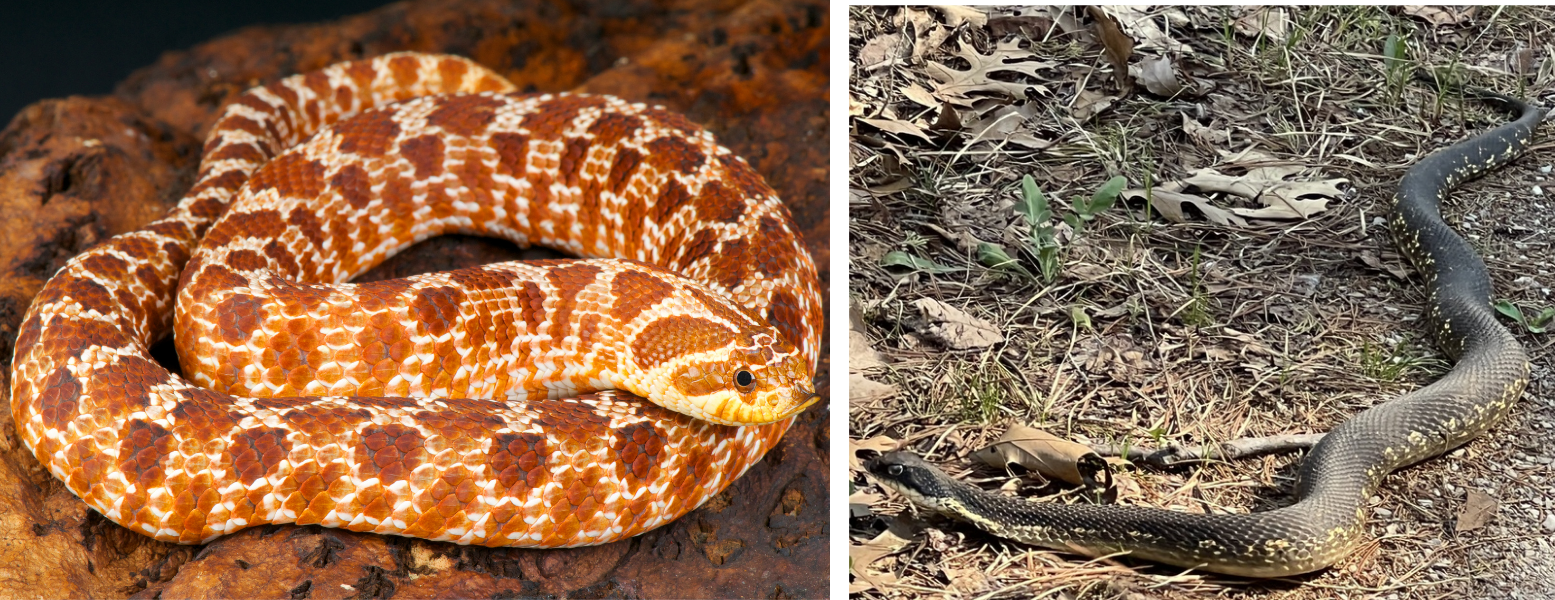
Hognose Snakes are thick-bodied, nonvenomous snakes in the Colubridae family. Large individuals can grow around 1 meter long, though the typical length is 60 to 90 cm. The color pattern varies widely, with some individuals being melanistic (completely black), while others are a mix of bright beige with dark brown blotches. Hognose snakes have keeled scales. The most distinguishing feature is the upturned, pointed snout – which gives this species its name.
It can take up to 5 years for Hognose Snakes to reach sexual maturity. Mating occurs typically in spring, but reproductive activities can also occur in the autumn. After mating, female snakes can lay a clutch of 4-61 eggs, usually in June or July. Hognose Snakes use their upturned snouts to dig a hole 7-20 cm, typically within sandy soil. Hatchlings emerge in August or September after 30-60 days of incubation. When temperatures drop in November, Hognose snakes will seek their hibernacula (winter hibernation habitat), usually in burrows within sand or abandoned mammal dens. These snakes are awake but sluggish, with a much-reduced metabolism.
The Eastern Hognose Snake is unique for its diet – American Toads (Anaxyrus americanus) comprises a substantial portion of their total diet for populations across the Great Lakes Region. Their upturned nose is especially adapted for digging and locating toads within the soil. Hognose Snakes also possess a pair of enlarged teeth at the back of the upper jaw, that are used to puncture inflated toads (inflation is a common defensive mechanism for toads), making them easier to swallow. Hognose snakes also produce enzymes that neutralizes toxins created by American Toads. Apart from toads, Eastern Hognose snakes will readily consume other species of frogs (Anura), insects, small mammals, and eggs of both reptiles and birds. The predators of Eastern Hognose Snake are the same species as those of Ontario’s other medium-sized snake species; these include Racoons (Proycon lotor), Skunks (Mephitis mephitis), Opposums (Didelphis virginiana), and birds-of-prey (Accipitriformes).
Hognose Snakes are also well-known for their defensive displays when threatened by predators. When first threatened, they will perform a dramatic bluff display – where the head and neck is flattened like a cobra. They will then hiss loudly and strike, usually with a closed mouth. If their elaborate display does not deter potential predators, Hognose Snakes will then “play dead”, rolling onto their back, open their mouths, and release a foul odour. If a startled snake is somehow flipped back towards normal orientation, it will immediately turn around again, belly facing up!
Fun Facts
- Despite their performative defensive displays – Eastern Hognose Snakes are completely harmless to humans!
- Eastern Hognose Snakes hibernate individually, rather than communally as in other snake species.
- Hognose Snake eggs have a leathery shell, allowing for some resiliency to external pressures, and allowing eggs to absorb moisture from the surrounding environment during incubation.
- Eastern Hognose Snakes are the only native snake species that can flatten the neck to form a distinct cobra-like hood!
- Even hatchlings right after emergence are known to play dead when threatened!
Written by Matthew Palarchio, HBSc in Environmental Sciences, Western University.
Photo Credits (L-R): Stock Photo retrieved from Canva, Matthew Palarchio (melanistic Hognose Snake)
The species you’ve just read about—and the ecosystems they depend on—need our protection. Support the work of the Long Point Basin Land Trust and help preserve the wild spaces of the Long Point Basin: https://longpointlandtrust.ca/donate
To view a directory of all species featured on our website, visit: https://longpointlandtrust.ca/featured-species

