
Description and ecology
Grey Catbird (Dumetella carolinensis) is migratory songbird and a member of the Mimic Thrush Family (Mimidae), found exclusively in the Americas. The Great Lakes Region has two other native species – the Brown Thrasher (Toxostoma rufum) and the Northern Mockingbird (Mimus polyglottos). The Grey Catbird is the only species in the Dumetella species, found throughout the eastern and central North America during the summer. In the winter, Catbirds migrate to the Gulf Coast in the U.S. southeast, Mexico, and throughout Mesoamerica as far south as Panama and northern Colombia.
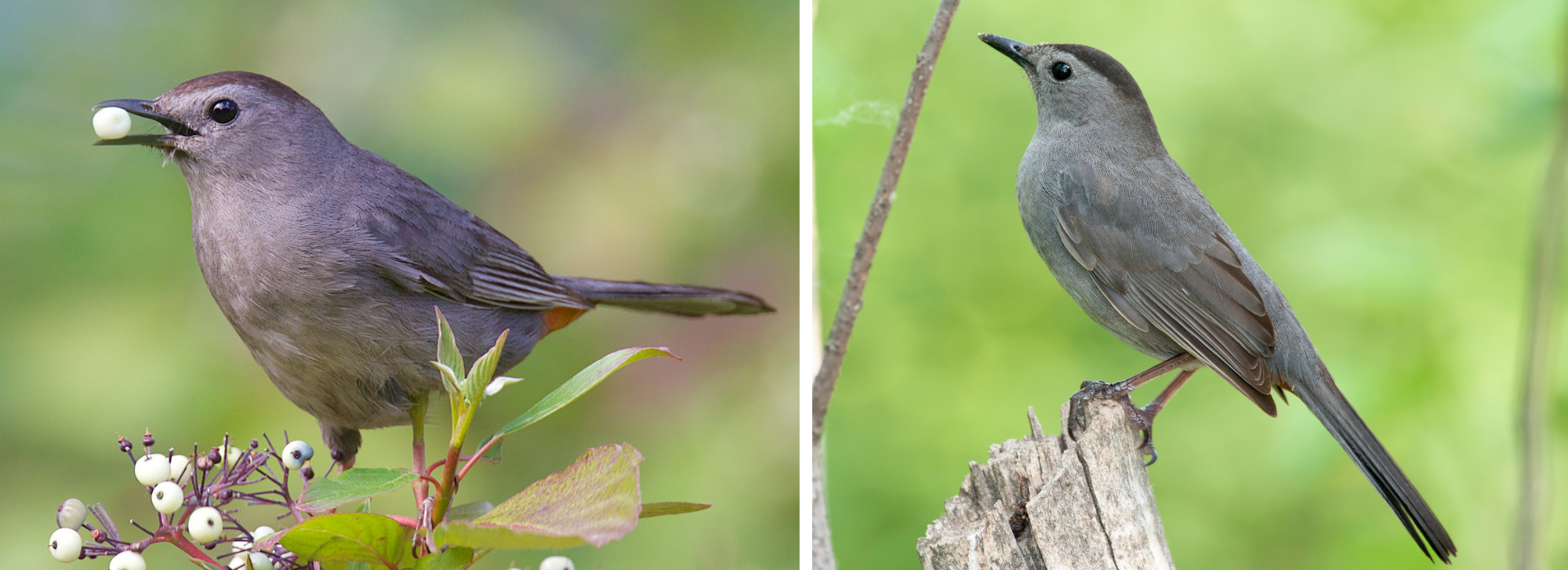
Catbirds are most often observed between May and September in the Great Lakes Region. It is usually found in open forests, oak savannas, shrublands, riparian areas, and less often, dense forests. In the spring, male Grey Catbirds will sing a wide variety of melodic songs, primarily to establish a breeding territory and to attract a female. Catbirds mock many other species, including the American Robin (Turdus migratorius), Northern Cardinal (Cardinalis cardinalis), Eastern Towhee (Pipilo erythrophthalmus), House Wren (Troglodytes aedon), Carolina Wren (Thryothorus ludovicianus), the Red-eyed Vireo (Vireo olivaceus), the Warbling Vireo (Vireo gilvus), and the Baltimore Oriole (Icterus galbula), Blue Jay (Cyanocitta cristata), and Wood Thrush (Hylocichla mustelina). By the end of July, male Catbirds sing much less frequently, instead vocalizing through a series of cat-like mew calls – common in late summer. Both males and females make these calls.
Grey Catbirds produce around 2 broods each summer, though the number varies depending on insect conditions, precipitation, and temperature. Each clutch has 1-6 turquoise eggs with red spots. Incubation, done primarily by the female, is completed in 14 days, while the nestlings are raised in 11 days till fledge. The male Catbird’s responsibility is to bring food and defend the nest site from other birds. This species forms monogamous pairs which are maintained at least through one breeding season. During the breeding season, Grey Catbirds consume insects, especially ants (Hymenoptera), beetles (Coleoptera), grasshoppers (Orthoptera), flies (Diptera), moths, butterflies, and caterpillars (different forms of the order Lepidoptera).
The last brood fledges at the beginning of August. Afterwards, Catbirds will focus their efforts on foraging throughout August and September. During this time, the fruits of many shrubs are ripe, providing an important food source for catbirds and many other songbirds. Commonly consumed fruits include cherries (Prunus sp.), grapes (Vitis sp.), serviceberries (Amelanchier sp.), dogwood berries (Cornus sp.), raspberries (Rubus sp.), elderberries (Sambucus sp.), sumac berries (Rhus sp.), chokeberries (Aronia sp.), spicebush (Lindera benzoin), and poison ivy berries (Toxicodendron sp.). Populations of Grey Catbirds are typically considered heathy by ecologists, with a breeding population of 30 million birds. They are often observed at migrant hotspots – such as Long Point, during both spring and autumn migration.
Written by Matthew Palarchio, HBSc in Environmental Sciences, Western University
All photos are Stock photos retrieved from Canva
The species you’ve just read about—and the ecosystems they depend on—need our protection. Support the work of the Long Point Basin Land Trust and help preserve the wild spaces of the Long Point Basin: https://longpointlandtrust.ca/donate
To view a directory of all species featured on our website, visit: https://longpointlandtrust.ca/featured-species

