
Introducing Long Point’s Turtles
Ontario has 9 native species of turtles: the Common Snapping Turtle (Chelydra serpentina), Eastern Spiny Softshell Turtle (Apalone spinifera), Northern Map Turtle (Graptemys geographica), Yellow-throated or Blanding’s Turtle (Emydoidea blandingii), Wood Turtle (Glyptemys insculpta), Painted Turtle (Chrysemys picta), Spotted Turtle (Clemmys guttata), Eastern Box Turtle (Terrapene carolina), and Eastern Musk Turtle (Sternotherus odoratus) – ordered from largest to smallest. Only 5 of these species are regularly observed in the Long Point Basin – Snapping, Softshell, Map, Blanding’s and Painted Turtles!
Description
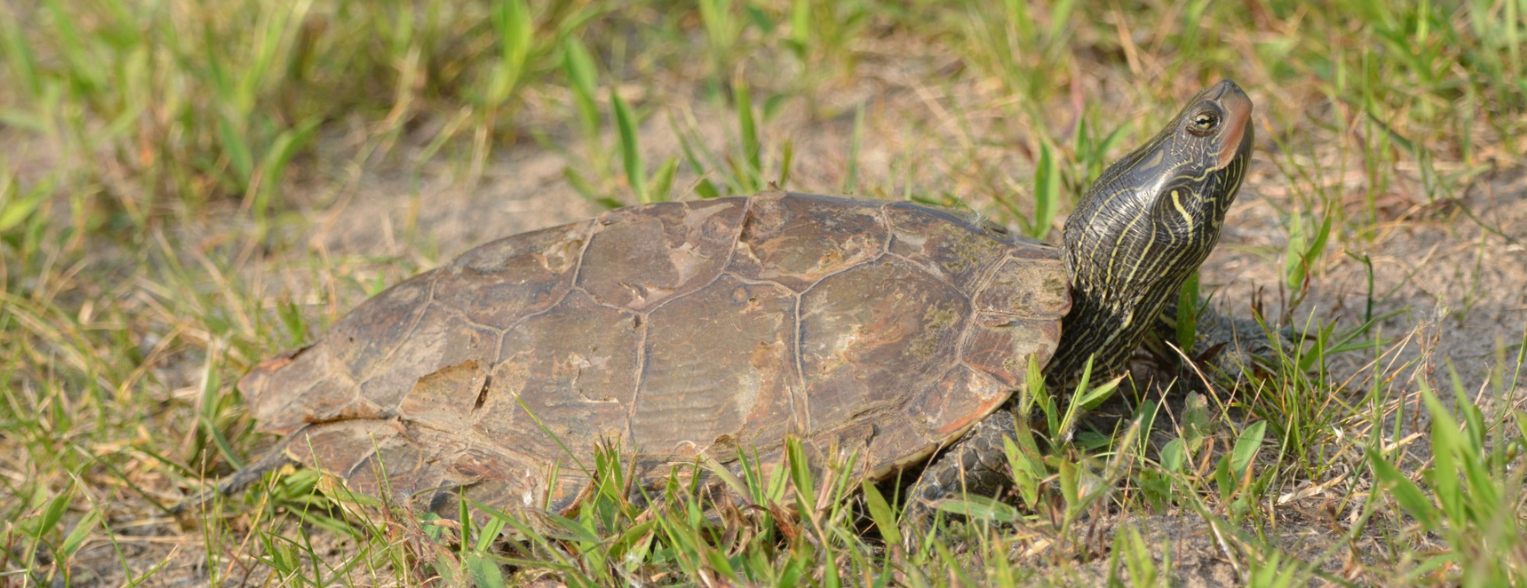
Northern Map Turtles are one of the larger species in the Long Point Basin. Female Northern Map Turtles can reach 27 cm in carapace (upper, outer shell) length, but full-grown males are only 15 cm in length. Females weigh up to 5 lbs and are around 30-50% larger than males. Map Turtles are named for their yellow linear markings on their olive-green carapace, which resemble the many lines of a topographical map. These markings are especially bright on the head and neck. The plastron (lower shell) is typically yellow in colour. They are most often confused with Painted Turtles, but the species have a few key differences. Apart from being smaller than average than Map Turtles, Painted Turtles have red markings at the perimeter of the plastron, and red markings on the neck, unlike Map Turtle, whose are yellow.
In the Long Point Basin, Map Turtles are active between late April and early October. They are most often observed in the month of June, which corresponds with the nesting period. Females lay 9-17 oval eggs in sandy soil near their wetland habitat. Map Turtles average 1-2 clutches per year. The temperature determines the sex of a turtle – when nest temperatures are over 27°C, the offspring are typically female, whereas colder nest temperatures result in male turtles. Through the remainder of the summer, Map Turtles are often observed basking in herbaceous marshes and other wetlands, especially on warm, sunny days. In August or September, the turtle hatchlings emerge after can incubation period of 50-70 days. Subsequentially, they will quickly move into water. If the hatchlings emerge later, they will overwinter in the nest, moving to nearby wetlands the following spring. They are capable of surviving temperatures of -8°C or lower.
Map turtles are omnivores, consuming both plant and animal matter. However, their diet leans more carnivorous, especially when food resources are abundant. Commonly consumed prey species include mollusks, insects, and crustaceans, including Crayfish (Astacidea). These turtles will supplement their diet with aquatic vegetation, providing important vitamins and minerals. Eggs and hatchings of Map Turtles are highly vulnerable to predators, especially medium-sized mammalian omnivores – such as Common Raccoons (Procyon lotor), Striped Skunks (Mephitis mephitis), and Opossums (Didelphis virginiana). They are also commonly consumed by large herons (Ardea sp.) and snakes (Squamata). Due to their large size, adults are more rarely predated, but they are occasionally consumed by weasels (Mustelidae), wolves (Canis lupus), and coyotes (Canis latrans).
If you would like to learn more about turtles, and other herpetofauna – I would recommend reading Ontario Nature’s Reptile and Amphibian Atlas (https://catalog.ontarionature.org/ontario-reptile-and-amphibian-atlas/page/1). Recently published in 2024, this ~300-page guide offers a plethora of comprehensive and informative content on herpetology, including detailed descriptions of the physical form and ecology of each species. Distribution maps are also provided for most species.
Fun facts
- Map Turtles are often observed basking communally, especially on rocks or logs adjacent to large areas of water.
- They typically do not breed until 10 years old, and Map Turtles can live 30-50 years, though the average lifespan is much shorter.
- Their nesting sites are often on sandy or gravelly shorelines. Female Northern Map Turtles will venture onto land to lay their eggs in sunny spots with loose soil or gravel. The availability, quality, and protection of these nesting sites are crucial for the reproductive success of Map Turtles in the Great Lakes Region!
- Map turtles are very agile in flowing water, allowing them to navigate throughout their environment and escape predators!
Written by Matthew Palarchio, HBSc in Environmental Sciences, Western University
Photo by Matthew Palarchio
The species you’ve just read about—and the ecosystems they depend on—need our protection. Support the work of the Long Point Basin Land Trust and help preserve the wild spaces of the Long Point Basin: https://longpointlandtrust.ca/donate
To view a directory of all species featured on our website, visit: https://longpointlandtrust.ca/featured-species

