
Northern Watersnakes (Nerodia sipedon sipedon) are semiaquatic, nonvenomous reptiles in the Colubridae family. It is widespread throughout the Great Lakes Region, found in a wide variety of freshwater ecosystems. It is one of two subspecies of watersnakes native to Ontario, the other subspecies, the Lake Erie Watersnake (Nerodia sipedon insularum) is endemic in Canada to Pelee Island and surrounding areas in western Lake Erie. The Northern Watersnake is considered a secure species, being quite abundant within it’s preferred habitat, whilst the Lake Erie Watersnake is designated as special concern on COSSARO. Watersnakes can be found throughout eastern North America, from the Great Lakes Region to Texas and Florida. The riparian forests in the Missouri River Basin extend their geographic range hundreds of kilometres westward into the otherwise treeless Great Plains.
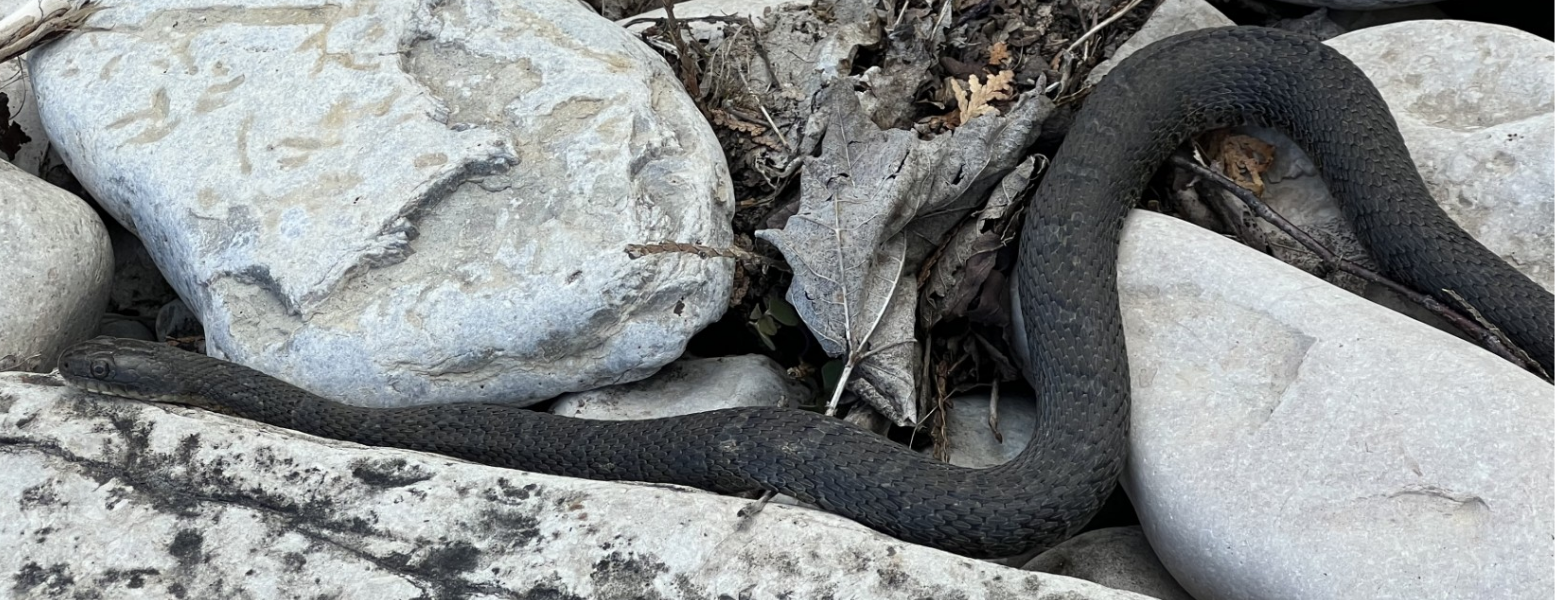
Description
Watersnakes are one of Ontario’s larger snake species, growing typically between 75 cm and 110 cm, with females being the larger sex. The colour is highly variable, but is generally brownish, greyish, or reddish-brown. Watersnakes usually have a pattern of dark crossbands or blotches on the back, with complementary blotches on the sides. Older Watersnakes often change colour to appear almost solid black, with their pattern greatly obscured. The scales are strongly keeled, giving them a rough texture. Compared to the body, the head is relatively broad and flattened.
In the Long Point Basin and throughout the Great Lakes Region, Northern Watersnakes typically inhabit streams, lakes, marshes, and ponds, as long as there is a permanent presence of freshwater. They are sometimes observed along the shores of the Great Lakes. Juvenile watersnakes prefer upstream tributaries, compared to adult snakes, which prefer major watercourses. When basking, watersnakes often use wetland vegetation overhanging above water, allowing for a quick escape if predators are present. Compared to other species, Northern Watersnakes are quite sedentary, with an activity range of under 20 ha (50 acres). They exhibit high site fidelity – utilizing the same habitats for hiding, basking, and hibernating year after year. Common hibernation sites include mammal burrows, abandoned beaver / muskrat lodges, crevices, and old building foundations. Northern Watersnakes are excellent divers and swimmers – an adaption to their mostly aquatic habitat.
Northern Watersnakes (like other snake species) are carnivorous and will consume a wide variety of prey, especially fish – their primary food source. Watersnakes supplement their diet with amphibians, such as frogs (Anura), and aquatic insects. They opportunistically hunt small mammals when they are close to the waters edge. They often consume their food headfirst while the prey is still alive. Watersnakes are also scavengers – they eat carrion.
Watersnakes are typically active between April and October, during both the day and night. They attain sexual maturity at 3 years of age. Mating season is in May, shortly after hibernation. Watersnakes will form “breeding balls” where multiple males pursue one female, a behaviour also observed in Green Anacondas (Eunectes maximus) – the largest snake in the world, living in the Amazon Rainforest. Unlike most of Ontario’s snakes (and like garter snakes, Thamnophis sp.), Northern Watersnakes are ovoviviparous – the eggs hatch within the female, and there is no external egg laying. Instead, live young emerge from female watersnakes. The total gestation time is between 58-70 days, and females give birth typically from August to October. Litter sizes range from 10-60 young, which are fully independent and must fend for themselves.
Fun facts
- Northern Watersnakes can remain submerged for long periods of time. They are capable of staying underwater for over an hour when escaping predators!
- Watersnakes have been observed directing schools of fish towards more accessible areas, making them easier to hunt and capture!
- Northern Watersnakes utilize a variety of hunting techniques – including active pursuit, probing, foraging, and ambush predation.
- When threatened by predators, Northern Watersnakes make a dramatic display, making them appear more menacing. They can also release foul smelling chemicals!
Written by Matthew Palarchio, HBSc in Environmental Sciences, Western University
Photo provided by Matthew Palarchio
The species you’ve just read about—and the ecosystems they depend on—need our protection. Support the work of the Long Point Basin Land Trust and help preserve the wild spaces of the Long Point Basin: https://longpointlandtrust.ca/donate
To view a directory of all species featured on our website, visit: https://longpointlandtrust.ca/featured-species

