
Ontario has 9 native species of turtles: the Common Snapping Turtle (Chelydra serpentina), Eastern Spiny Softshell Turtle (Apalone spinifera), Northern Map Turtle (Graptemys geographica), Yellow-throated or Blanding’s Turtle (Emydoidea blandingii), Wood Turtle (Glyptemys insculpta), Painted Turtle (Chrysemys picta), Spotted Turtle (Clemmys guttata), Eastern Box Turtle (Terrapene carolina), and Eastern Musk Turtle (Sternotherus odoratus) – ordered from largest to smallest. In many areas of the Great Lakes, especially landscapes with a more pronounced human influence, the Painted Turtle is the most common species of turtle.
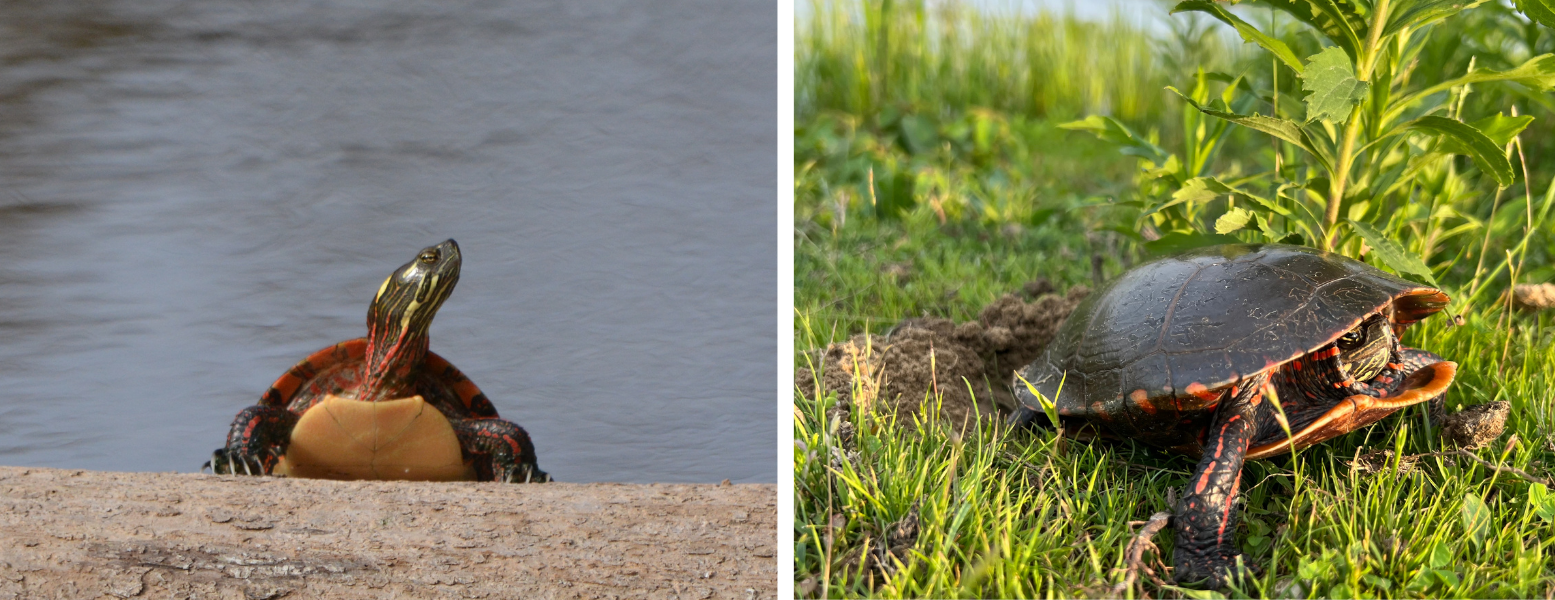
Description
Painted Turtles are small freshwater turtles in the family Emydidae – also known as pond turtles. The carapace measures 15-25 cm on females. Males are smaller, 12-20 cm. Females being larger than males is typical for Ontario’s turtles – with the notable exception of Snapping Turtles, where both sexes are similar sized. Painted Turtles are very widely distributed North America, with populations divided into 4 different subspecies. The Painted Turtle native to the Great Lakes Basin is the Midland Painted Turtle (C. picta marginata). To the east of the Appalachians is the Eastern Painted Turtle (C. picta picta), the nominate subspecies, distributed from Nova Scotia south to Georgia. The Southern Painted Turtle is found south of the confluences of the Ohio, Tennessee and Mississippi Rivers. There, it is most often found in Bald Cypress (Taxodium distichum) and Tupelo (Nyssa sp.) swamps. The fourth and most broadly distributed species is the Western Painted Turtle (C. picta bellii). Starting the west side of Lake Michigan and Lake Superior, turtle populations extend hundreds of miles into the Great Plains along major rivers, such as the Missouri, and floodplain forests dominated by Eastern Cottonwood (Populus deltoides). Western Painted Turtles are found west of the Rocky Mountains as well, in the Columbia River Basin, and even as far west as Vancouver Island!
Midland Painted Turtles are active from March to early November, but they are most often observed in the spring and summer months. In the Long Point Basin, Painted Turtles are primarily observed in herbaceous marshes and ponds, though they are occasionally found in swamps and along riverbanks. They are largely diurnal, basking on exposed rocks and logs within wetlands to regulate their body temperature (like other turtles – since they are ectothermic). These turtles often repeatably bask and forage multiple times a day, returning to the water once their body temperature is sufficiently heated. Large groups of turtles are often observed close together on a single surface, especially during warm, sunny days.
Sexual maturity is attained at 10 years of age. Painted Turtles breed in the spring and the autumn – the latter time is unusual for a North American turtle. Sperm can remain viable for up to 3 years. Since both males and females are promiscuous, clutches can have multiple fathers. Following mating, female Painted Turtles will begin nesting, typically in June. Nesting sites are typically within 200 m from water. These turtles have high nest site fidelity – returning to the same areas year after year. Painted Turtles will utilize their hind legs to dig the nest. They also dig several false nests – an adaption to confuse predators. It usually takes a female Painted Turtle around 4 hours to complete nest construction. Females lay 2-5 clutches per year, each with 3-17 elliptical, creamy-white eggs. Around 30-50% of adult females do not breed in any one year. The eggs are incubated for around 60-90 days, and hatch in August or September. If emergence is any later, the turtles will remain in the nest to overwinter, tolerating temperatures of down to -10°C, a product of antifreeze. Similarly to other turtles, temperature determines sex, with hotter nest temperatures producing more females.
When temperatures begin plummeting in November, Painted Turtles will begin hibernation. They typically hibernate at the bottom of a lake, pond, or aquatic marsh, encasing their bodies with mud. At low temperatures, they can survive long periods of nearly anoxic conditions in the water. Painted Turtles then rely on anaerobic respiration, which leads to the production of lactic acid. A high concentration of lactic acid can lead to imbalances in blood pH (acidity) levels, and hindered enzyme function – however, turtles buffer against this by releasing calcium and magnesium carbonates, which will react with the acid to neutralize it, as well as drastically reducing their metabolic rate during hibernation (>95% is typical).
Painted Turtles are omnivorous, foraging during the day in their aquatic habitat. Young turtles primarily consume aquatic insects, small fish, tadpoles, mollusks, and carrion. Older turtles are more likely to consume plant matter – such as waterlilies (Nymphaeaceae) and duckweed (Lemna minor). Predators of Painted Turtles include Racoons (Procyon lotor), Striped Skunks (Mephitis mephitis), weasels (Mustelidae), Foxes (Vulpes vulpes), and Crows (Corvus brachyrhynchos), which primarily feed on the eggs. All of these species also feed on hatchlings, as well as Bullfrogs (Lithobates catesbeianus), Herons (Ardea sp.), Falcons (Falconiformes) and other raptors (Accipitriformes). Adult Painted Turtles are occasionally consumed but are more rarely predated due to their large hard shells – an effective defensive adaptation for Painted Turtles.
Fun facts
- Painted turtles have tongues that don’t move freely, so they need to be submerged in water to properly swallow their food!
- Shells of adult Painted Turtles have among the largest concentrations of carbonate in the animal kingdom! These large reserves help the painted turtle buffer the accumulation of lactic acid during anoxia. Painted Turtles can survive up to 150 days of anoxic conditions each winter!
- A Painted Turtle’s shell is not a separate exterior casing – but an essential part of the skeleton, which includes the backbone. There are around 60 bones in each turtle shell.
- In ideal conditions, Painted Turtles can live over 60 years in the wild!
Written by Matthew Palarchio, HBSc in Environmental Sciences, Western University
All photos provided by Matthew Palarchio
The species you’ve just read about—and the ecosystems they depend on—need our protection. Support the work of the Long Point Basin Land Trust and help preserve the wild spaces of the Long Point Basin: https://longpointlandtrust.ca/donate
To view a directory of all species featured on our website, visit: https://longpointlandtrust.ca/featured-species

