
The Smooth Greensnake (Opheodrys vernalis) is an reptile species found throughout Ontario’s Great Lakes Region, especially within grasses and vegetation. In the Long Point Basin, they are most often found in open habitats – such as meadows, tallgrass prairies, wetland edges, and pastures.
Description
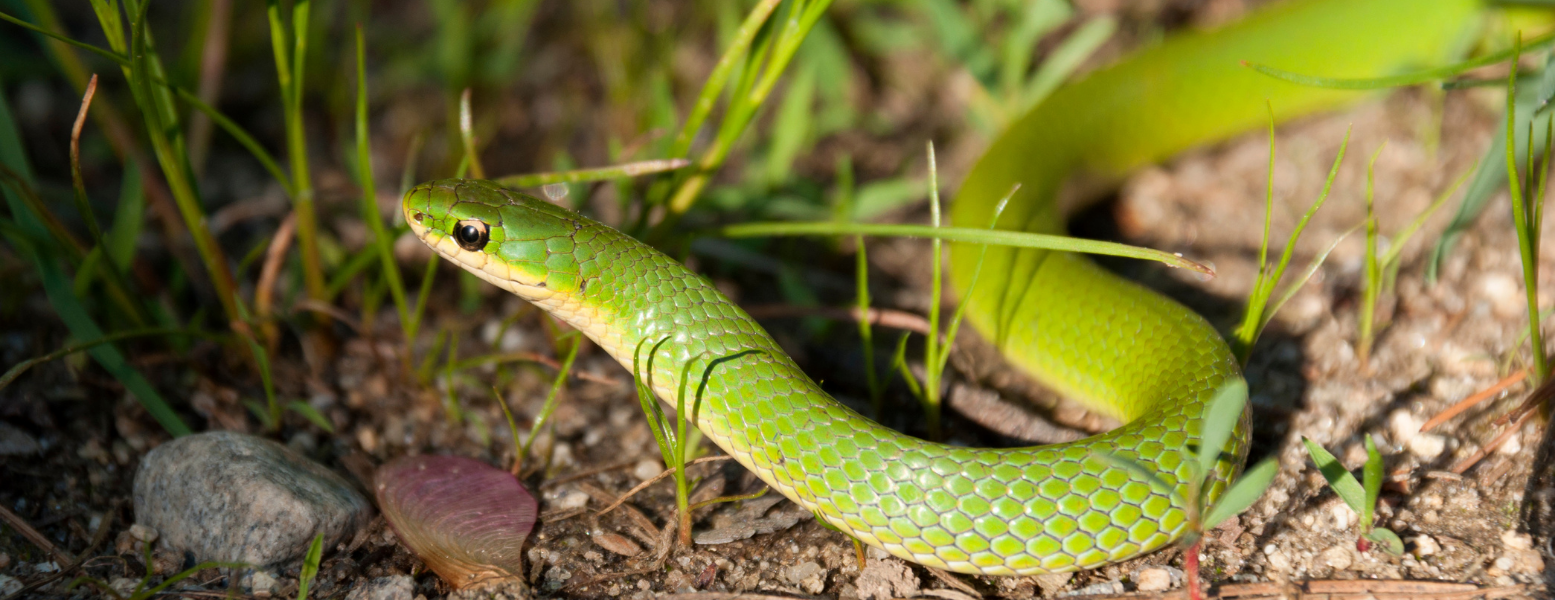
Smooth Greensnakes are small snakes measuring 30-50 cm. Their most distinctive feature is their colour pattern, which is bright green on the back and creamy white on the underside. It has smooth scales, unlike the Rough Greensnake (Opheodrys aestivus), a similar species found in the southeastern United States. The head is slightly wider compared to the rest of the body. Smooth Greensnakes can be found throughout the Great Lakes Region to the Atlantic coast. Populations also extend west across the Northern Great Plains in southern Manitoba, Saskatchewan, North Dakota, South Dakota, and Minnesota. Isolated populations of Greensnakes are also found throughout the southern Rocky Mountains, especially in Colorado, Utah, and New Mexico. These reptiles are primarily diurnal. Like species, Smooth Greensnakes often bask in the sun – usually on exposed logs or rocks.
Greensnakes reach sexual maturity at 2 years of age. The breeding season occurs from late April to early July. Males are attracted to females by the scent they produce. Both sexes are promiscuous. Females lay two clutches per season on average, with a clutch size of 3-13 eggs. Smooth Greensakes will often choose warm, damp sites for nesting, including old mammal burrows or rotting logs. When temperatures begin dropping in November, Smooth Greensnakes will seek their hibernacula – winter habitat, where they will remain until April. They can live up to six years.
Unlike many of Ontario’s snakes, Smooth Greensnakes are primarily insectivores – they consume caterpillars (Lepidoptera), crickets & grasshoppers (Orthoptera), ants (Hymenoptera), spiders (Arachnida), and occasionally earthworms (Clitellata). Predators of Greensnakes include raptors (Acciptriformes & Falconiformes), herons (Ardea sp.), Common Racoons (Procyon lotor), Striped Skunks (Mephitis mephitis), Coyotes (Canis latrans), and Red Foxes (Vulpes vulpes). They are also consumed by larger snake species, especially the Eastern Foxsnake (Pantherophis vulpinus), Grey Ratsnake (Pantherophis spiloides), and Eastern Hog-nosed Snake (Heterdon platirhinos)! Domestic cats (Felis catus) are also a predator to Greensnakes, especially when they are running loose in rural areas. When threatened by predators, Smooth Greensnakes will attempt to flee rapidly, relying on speed and camouflage to make an effective escape!
Fun facts
- Greensnakes are often known as “Grass Snakes” across North America, due to their effective camouflage in vegetation and affinity for grassy habitats.
- Smooth Greensnakes consume many common garden insects – making these reptiles a natural pest control!
- They are quite docile. Greensnakes are far more likely to release a skunk-like odour than bite even if attacked by predators.
- Smooth Greensnakes have tiny small, needle-like teeth – adapted for grasping and holding onto small, squirming invertebrates like caterpillars and crickets.
Written by Matthew Palarchio, HBSc in Environmental Sciences, Western University
Photo provided is a Stock Image retrieved from Canva
The species you’ve just read about—and the ecosystems they depend on—need our protection. Support the work of the Long Point Basin Land Trust and help preserve the wild spaces of the Long Point Basin: https://longpointlandtrust.ca/donate
To view a directory of all species featured on our website, visit: https://longpointlandtrust.ca/featured-species

