
The Spicebush Swallowtail (Papilio trioilus) is one of six native swallowtail butterflies in the Great Lakes Region, with populations concentrated in the areas surrounding Lake Erie. It is observed throughout the Long Point Basin and other southern areas, such as Rondeau, Skunk’s Misery, the AuSable River Basin, and Pinery Provincial Park, all within the the Eastern Deciduous Forest Region (Carolinian Life Zone). It is also found in the Lake Huron coastal region north to Greenock Swamp in Bruce County (Ontario’s largest deciduous swamp), at around 44 N latitude. Around Long Point, it most often occurs in deciduous forests, oak savannas, swamps, meadows, and riparian forests, wherever it’s host plants, members of the Laurel Family (Lauraceae) are found. Other swallowtail species include the Eastern Tiger Swallowtail (Papilio glaucus), the Canadian Tiger Swallowtail (Papilio canadensis), the Black Swallowtail (Papilio polyxenes), and the Giant Swallowtail (Papilio cresphontes) – North America’s largest butterfly. Occasionally, the Pipevine Swallowtail (Battus philenor) and Zebra Swallowtail (Eurytides marcellus) will occur in the region surrounding Lake Erie, but these are much rarer than the other species.
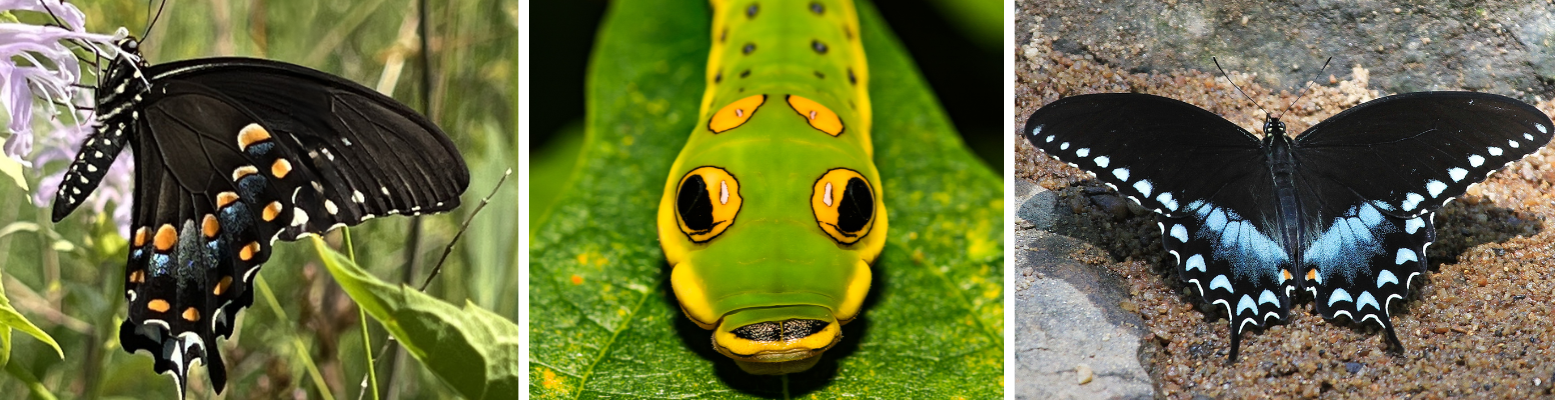
Description
The Spicebush Swallowtail is a large butterfly, with a wingspan of around 8-11 cm. Males are black with a greenish-blue sheen on their hindwings, while females have more prominent blue scaling on their hindwings. The dark coloration of the Spicebush Swallowtail is a classic example of Batesian mimicry, utilized for protection against predators by mimicking the unpalatable Pipevine Swallowtail. Each summer, 2 to 3 generations of Spicebush Swallowtails occur each year, with typically two generations in the north and up to three in the south. Females will lay their eggs singly on the underside of a host plant leaf near a nectar source. In Ontario, the two primary larval host plants utilized by Spicebush Swallowtails are (unsurprisingly!) Spicebush (Lindera benzoin) and Sassafras (Sassafras albidum). They occasionally utilized more distantly related Magnoliids such as Tuliptree (Liriodendron tulipifera) and Cucumber Magnolia (Magnolia acuminata). The caterpillars grow rapidly for about 3-4 weeks before pupating, with 5 instars. Young caterpillars mimic bird droppings, while later instars are green with very large “eyespots” (the biggest of all native swallowtail species), resembling a snake’s head, which is quite intimidating to potential predators. To the human eye, it looks like a cute caterpillar found in a children’s book. When threatened, the head of the caterpillar is retracted, exposing their osmeterium – a bright yellow organ at the back of the head. This organ releases a foul-smelling, often acidic, mixture of terpenes and other organic compounds. This noxious odour and taste act as a strong deterrent to ants, small spiders, wasps, and even some birds. Adult swallowtail butterflies rely on agility and camouflage to deter predators. Depending on the season of pupation, the chrysalis will either grow and emerge as a butterfly within a few weeks, or they will overwinter as a chrysalis. Larvae hatched in the autumn will often overwinter as a pupa, usually finding refuge in leaf litter. The pupa will pause its development until temperatures rise in the spring. Spicebush Swallowtail pupae will produce chemical proteins that acts as an antifreeze during the cold winter months. After the pupa stage, the adult butterfly emerges in May and is hungry for nectar. Preferred nectar sources include a wide variety of flowers, with milkweeds (Asclepias sp.) being commonly used. Adult butterflies live for around 2 to 14 days. In that time, the butterfly must eat, mate, and reproduce before it perishes. Males will exhibit a puddling behavior, where they land on damp soil or mud puddles to consume important minerals, such as sodium ions and amino acids. These chemicals are incorporated into the butterfly’s sperm, increasing the reproductive fitness of male Spicebush Swallowtails. During mating, the male Spicebush Swallowtail transfers these important chemicals to the female, increasing egg viability. Afterwards, female Spicebush Swallowtail Butterflies will look for the larval host plants.
Fun facts
- Spicebush Swallowtail caterpillars are expert “leaf rollers”. They use silk to pull and fold a leaf around themselves, creating a secure, silk-lined shelter where they hide during the day and emerge to feed at night. This mechanism provides excellent protection!
- Spicebush Swallowtails (along with the closely related Palamedes Swallowtails of the southeastern United States, Papilio palamedes) have a better ability to regulate the temperature of their thoraxes than some other swallowtail species due to their darker body and wing color. This allows them to remain active and feed in cooler temperatures
- Female Spicebush Swallowtails are capable of learning and remembering the scent of suitable host plants. This mechanism allows them to become efficient at locating the specific plants on which to lay their eggs, thereby increasing their reproductive success!
Written by Matthew Palarchio
Photo Credits: Matthew Palarchio (Spicebush Swallowtail adult on Bergamot, Monarda fitstulosa flower), Stock Photo retrieved from Canva (caterpillar), Stock Photo from Canva (Spicebush Swallowtail adult)
The species you’ve just read about—and the ecosystems they depend on—need our protection. Support the work of the Long Point Basin Land Trust and help preserve the wild spaces of the Long Point Basin: https://longpointlandtrust.ca/donate
To view a directory of all species featured on our website, visit: https://longpointlandtrust.ca/featured-species

