
Ontario has 9 native species of turtles: the Common Snapping Turtle (Chelydra serpentina), Eastern Spiny Softshell Turtle (Apalone spinifera), Northern Map Turtle (Graptemys geographica), Yellow-throated or Blanding’s Turtle (Emydoidea blandingii), Wood Turtle (Glyptemys insculpta), Painted Turtle (Chrysemys picta), Spotted Turtle (Clemmys guttata), Eastern Box Turtle (Terrapene carolina), and Eastern Musk Turtle (Sternotherus odoratus) – ordered from largest to smallest. The Eastern Spiny Softshell is arguably the most distinctive in appearance in comparison to other Ontario turtles.
Description
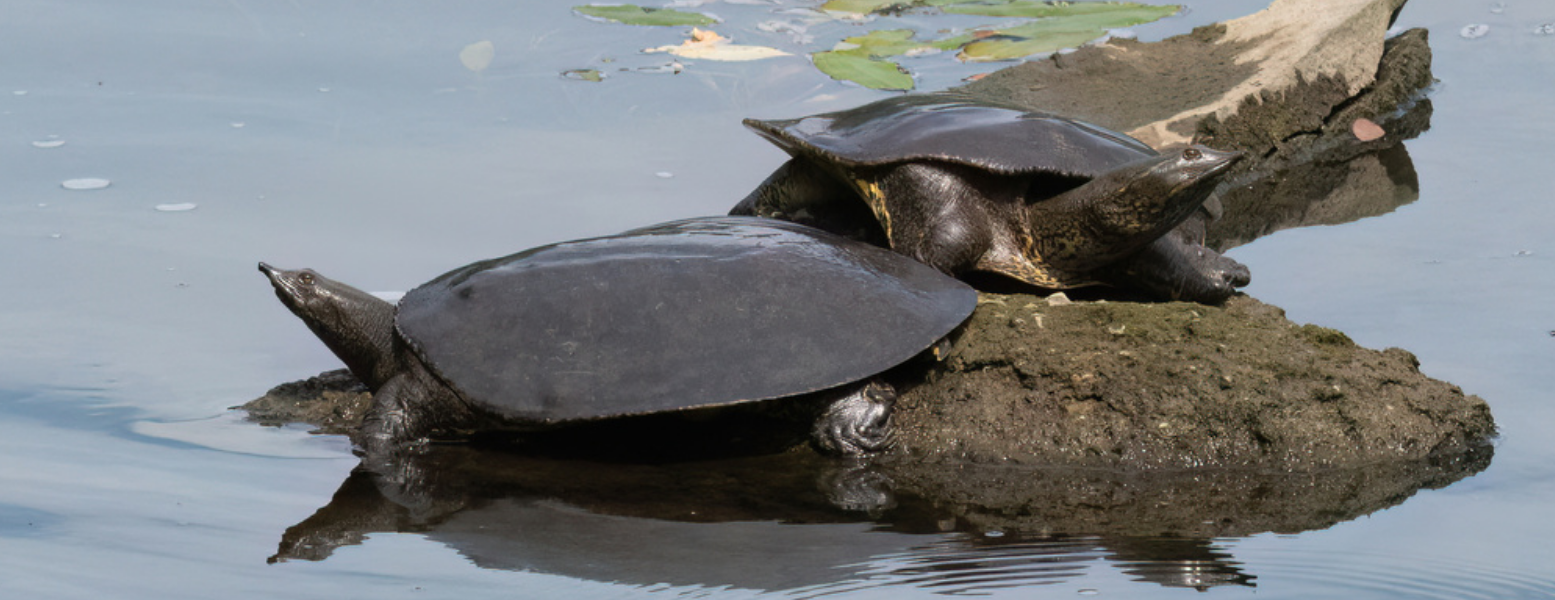
The unique appearance of the Eastern Spiny Softshell turtle is attributed to the carapace, which is flat, round, and leathery (rather than hard and bony, as in other turtles). Many individuals, especially juveniles, have distinctive black spots on the underside of the turtle. The carapace is olive green, brownish or greyish green, blending into the surrounding environment. The anterior (front) side of the carapace has spiny projections, giving this turtle its name! Spiny Softshell plastrons are greatly reduced in size, having small, dark blotches. The head is also unique – narrow and elongated, with snorkel-like snout, with only nostrils exposed. This allows Spiny Softshell to breathe underwater with only their nostrils exposed over the water. These turtles have webbed feat, similar to many duck (Anatidae) species, making them powerful swimmers.
Eastern Spiny Softshells can be found throughout a large portion of North America, stretching from Ontario and Quebec, south through most of the eastern United States to Tamaulipas, Nuevo León, Coahuila, and Chihuahua in Mexico. Through human-induced introduction and climate change, they are spreading northward. Within the Long Point Basin, these turtles are found within a wide variety of habitats. They are found in aquatic habitats, especially along major waterbodies, such as Big Creek and the Long Point Peninsula (as well as the Thames River valley north of the Long Point Region, around London). Spiny Softshells typically swim at depths less than 2 m deep. Like other turtles, Spiny Softshells are ectothermic, exhibit basking behaviour as a means to thermoregulate internal body temperature. Compared to other species, Spiny Softshells heat up and cool down relatively quickly, making effective basking vital. They are often observed basking on rocks exposed along major watercourses or wetlands, as well as sandy areas.
Spiny Softshell turtles mature between ages 8 and 10, with a potential lifespan of 50 years. Mating occurs in late spring (typically May), submerged within water. In June, the females will look for nesting sites to deposit their eggs. Sunny well-drained nesting sites, especially riverbanks, sandbars, shoreline dunes, and wetland edges, are ideal habitat. Clutch size is usually between 6-40 eggs. Larger females can sometimes lay 2 clutches per summer. The hatchlings emerge after 60-75 days, in August or September. Hibernation sites are well-oxygenated, muddy or sandy areas at the bottom of waterbodies, usually less than 2 m deep. Between seasons, Spiny Softshells can migrate up 10 km.
Eastern Spiny Softshells primarily consume aquatic invertebrates, especially crayfish (Astacidea), mollusks and aquatic insects. They also consume tadpoles, earthworms (Annelida), minnows (Cyprinidae), and carrion. Spiny Softshells are ambush predators, concealing themselves until a prey species swims nearby – then they strike rapidly with quick thrusts. Eastern Spiny Softshell turtles have a wide variety of predators, which typically feed on eggs and hatchlings. Predators include Racoons (Procyon lotor), Skunks (Mephitis mephitis), Red Fox (Vulpes vulpes), Coyote (Canis latrans), weasels and minks (Mustelidae), snakes (Serpentes), crows (Corvus brachyrhynchos), Great Egrets (Ardea alba), Great Blue Herons (Ardea herodias), Snapping Turtles and many other species.
Fun facts
- Eastern Spiny Softshells are very fast swimmers, and equally agile on land. This makes them powerful predators of a wide variety of organisms.
- Spiny Softshells absorb oxygen through their permeable skin, like many other reptiles. This adaptation is especially important for survival during the long winter months, when hibernating.
- The spots on the carapace characteristic of juveniles and males disappear in adult females, giving their shells a more uniform appearance.
- Shells of Eastern Spiny Softshells are very sensitive to vibrations in the water – allowing them to detect the locations of prey and potential predators.
- Unlike other turtle species, female Spiny Softshells will lay perfect round eggs reminiscent of ping-pong balls!
Written by Matthew Palarchio, HBSc in Environmental Sciences, Western University
Photo by Adam Jackson
The species you’ve just read about—and the ecosystems they depend on—need our protection. Support the work of the Long Point Basin Land Trust and help preserve the wild spaces of the Long Point Basin: https://longpointlandtrust.ca/donate
To view a directory of all species featured on our website, visit: https://longpointlandtrust.ca/featured-species

