
The Long Point Basin along Lake Erie (extending from Port Stanley to Port Dover), is home to 19 species of reptiles, encompassing 7 turtle species and 12 snake species. This region contains the largest remaining natural habitats on the Canadian side of Lake Erie, with a very high concentration of wildlife! Considering the extensive habitat loss in many parts of southwestern Ontario, most of Long Point’s turtles, and close to ~40% of snakes are listed on COSSARO, thus considered to be species-at-risk at a provincial level.
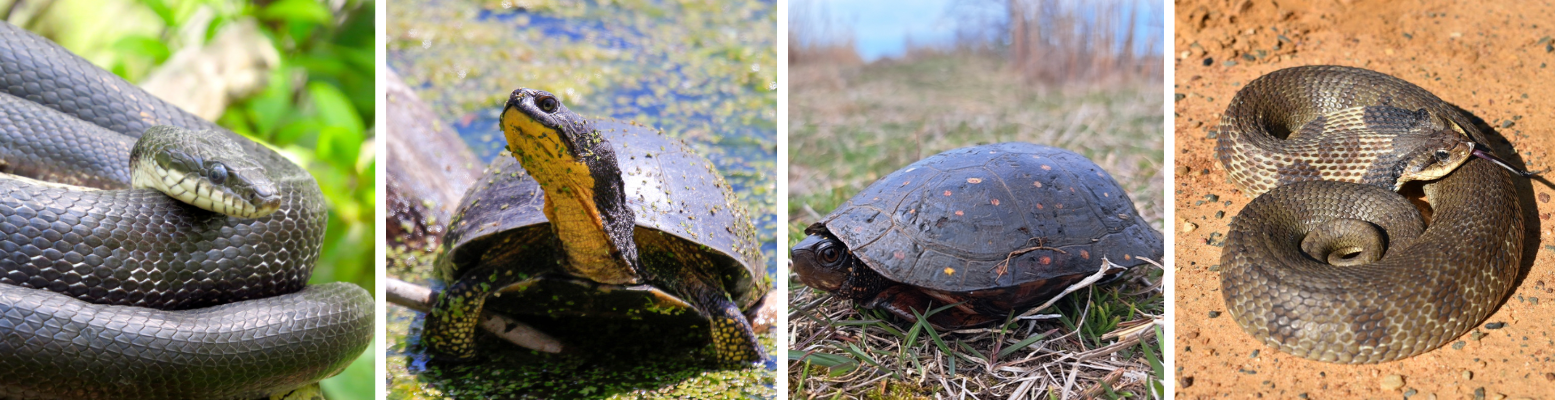
A list of native reptiles within the Long Point Basin, and their conservation status:
Turtles
- Midland Painted Turtle (Chrysemys picta marginata)
- Snapping Turtle (Chelydra serpentina) – special concern
- Northern Map Turtle (Graptemys geographica) – special concern
- Eastern Musk Turtle (Sternotherus odoratus) – threatened
- Spiny Softshell (Apalone spinifera) – endangered
- Blanding’s / Yellow-throated Turtle (Emydoidea blandingii) – endangered
- Spotted Turtle (Clemmys guttata) – endangered
Snakes
- Eastern Gartersnake (Thamnophis sirtalis sirtalis)
- Northern Watersnake (Nerodia sipedon)
- Eastern Milksnake (Lampropeltis triangulum)
- Brownsnake (Storeria dekayi)
- Smooth Greensnake (Opheodrys vernalis)
- Red-bellied Snake (Storeria occipitomaculata)
- Northern Ring-necked Snake (Diadophis punctatus edwardsii)
- Eastern Ribbonsnake (Thamnophis sauritus septentrionalis) – special concern
- Eastern Hog-nosed Snake (Heterodon platirhinos) – threatened
- Queensnake (Regina septemvittata) – endangered
- Eastern Foxsnake (Pantherophis gloydi) – endangered
- Grey Ratsnake (Pantherophis spiloides) – endangered
If you would like to learn more about turtles, and other herpetofauna – considering looking at Ontario Nature’s Reptile and Amphibian Atlas (https://catalog.ontarionature.org/ontario-reptile-and-amphibian-atlas/page/1). Recently published in 2024, this ~300-page guide offers a plethora of comprehensive and informative content on herpetology, including detailed descriptions of the physical form and ecology of each species. Distribution maps are also provided for most species.
Conservation efforts
The Long Point Basin Land Trust works with volunteers, landowners, and conservation partners to help conserve reptile diversity, as well as the ecosystems that support reptiles and many other wildlife species! The conservancy encourages the public to report any reptile sightings by emailing info@longpointlandtrust.ca.
A wide variety of conservation activities are conducted by Long Point Basin Land Trust to restore reptile populations and improve reptile habitat. This includes monitoring snake wintering areas – termed hibernacula, to determine the mortality rate of snake populations. Nesting structures have been also constructed for turtles – and for both groups, there is documented use of these habitats.
Long Point Basin Land Trust actively works alongside conservation partners to reduce roadside reptile mortality. This has included the construction and maintenance of a wildlife barrier in the Big Creek Section of the Long Point National Wildlife Area, making the roads safer for both wildlife and drivers. Hundreds of reptiles have been protected from vehicle strikes since the fencing as installed!
An effective outreach and education program has also improved public awareness of imperilled wildlife of the Long Point Basin, strongly in need of protection! Long Point Basin Land Trust distributes many forms of media, including fliers, factsheets, and online resources. Results from surveys done over the past 30 years show an increased interest in Long Point’s reptiles and their ecology – leading to conservation actions that protect wildlife!
The Long Point Basin Land Trust’s primary mission is to protect the biodiversity and habitats of the Long Point Basin area – which involves the securement of land parcels with high-quality ecosystems where wildlife is most abundant. To date, Long Point Basin Land Trust has secured 17 nature reserves spanning ~1200 acres (~500 hectares), with more in the works! These protected areas expand upon a vast conservation network established by Long Point Basin’s partners, such as the Nature Conservancy of Canada, the Long Point Region Conservation Authority, the County of Norfolk, the Canadian Wildlife Service, and the Ontario Ministry of the Environment, Conservation, and Parks, as well as other smaller organizations. Through years of conservation efforts and ecological restoration, many protected habitats have become interconnected, allowing wildlife to move across large landscapes with minimal disturbance.
Tips to help reptiles in the Long Point Basin:
- Drive carefully and watch for wildlife on roads, especially during the breeding season (May – July), and when turtle hatchlings are most active (August & September).
- Slow down near natural areas where high populations of reptiles occur, including woodlands, wetlands, and protected areas (provincial parks, etc.).
- Boat slowly in shallow water and near wetlands to avoid collisions with reptiles (in particular, the marshes surrounding Long Point and Turkey Point)
- Protect and restore natural habitats, including hedgerows, buffer strips along streams, woodlands and wetlands.
- Report suspected poaching of reptiles, or other illegal activities, to the OMNR TIPS line: 1-877-TIPS-MNR (1-877-847-7667)
- You can help LPBLT learn more about the status of local reptile populations and plan effective, locally-tailored conservation programs, by reporting your observations of reptiles, by emailing info@longpointlandtrust.ca
Written by Matthew Palarchio, HBSc in Environmental Sciences, Western University
Photos Credits (L-R): Grey Ratsnake (provided by Canva), Blanding’s Turtle (provided by Canva), Spotted Turtle (© Reuven Martin), Eastern Hognose Snake (© Philip Vanbergen).
The species you’ve just read about—and the ecosystems they depend on—need our protection. Support the work of the Long Point Basin Land Trust and help preserve the wild spaces of the Long Point Basin: https://longpointlandtrust.ca/donate
To view a directory of all species featured on our website, visit: https://longpointlandtrust.ca/featured-species

