
Ontario has 9 native species of turtles: the Common Snapping Turtle (Chelydra serpentina), Eastern Spiny Softshell Turtle (Apalone spinifera), Northern Map Turtle (Graptemys geographica), Yellow-throated or Blanding’s Turtle (Emydoidea blandingii), Wood Turtle (Glyptemys insculpta), Painted Turtle (Chrysemys picta), Spotted Turtle (Clemmys guttata), Eastern Box Turtle (Terrapene carolina), and Eastern Musk Turtle (Sternotherus odoratus) – ordered from largest to smallest.
Description
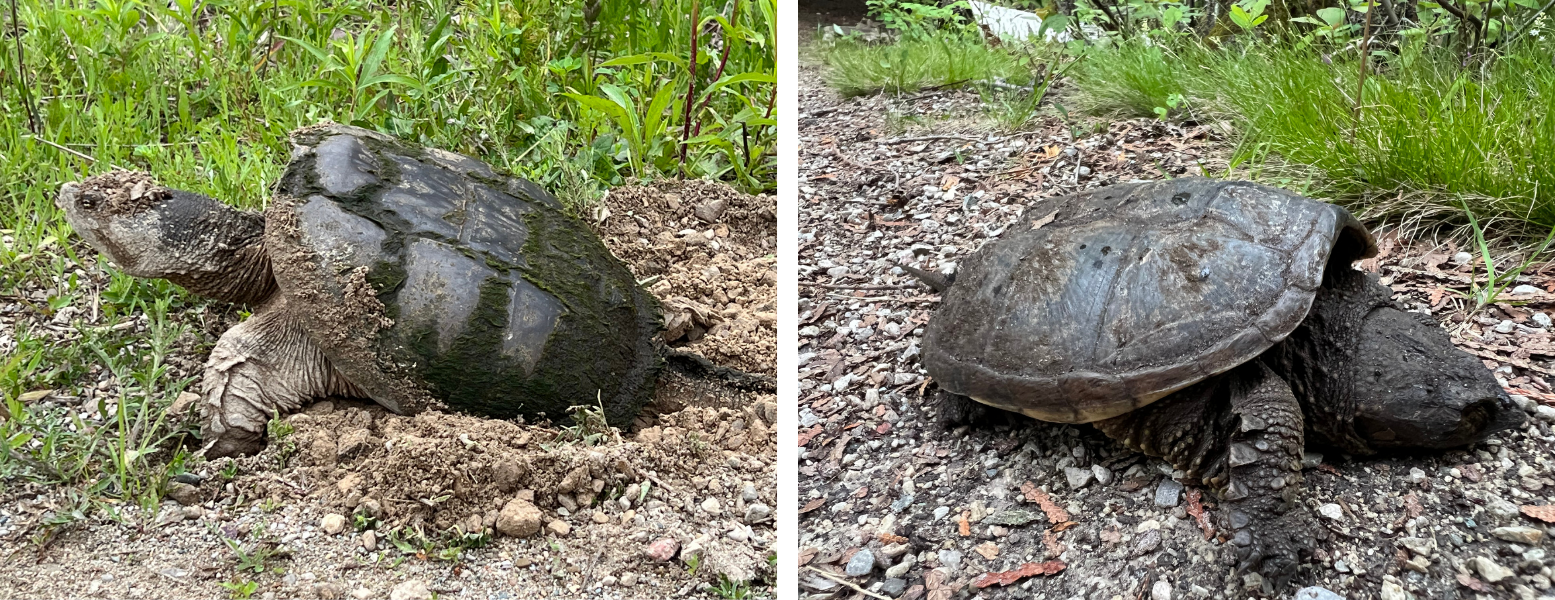
Common Snapping Turtles are large freshwater turtles, weighing up to 16 kg (35 lbs). They are one of only two species of snapping turtles (Chelydridae), the other species being the even larger Alligator Snapping Turtle (Macrochelys temminckii), in fact the largest freshwater turtle in North America! The Alligator Snapping Turtle is named for it’s three dorsal ridges of large scales – making its appearance loosely reminiscent of that of an alligator. which occurs in the swamps and bayous of the southeastern United States (especially within coastal Louisiana, Mississippi, Alabama, Florida, Georgia and South Carolina). The earliest known ancestor of Snapping Turtles occurred over 65 million years ago in the Cretaceous period – alongside dinosaurs! Despite occurring in the present, modern Snapping Turtles are ancient looking reptiles, with a rough, grey-green carapace (upper shell) often covered in algae. Snapping Turtle carapaces (upper shell) measure 20 cm to 50 cm on mature adults. Their plastrons (lower shell) are disproportionately small and cross-shaped, offering very little protection. They have proportionately large heads and triangular pointed snouts. Snapping Turtle tails are long and thick, and covered in saw-like projections called keels. They have muscular and stout limbs with strong claws and webbed feat, while their skin is rough with a tuberculated (bumpy) texture.
Snapping Turtles are a relatively early species of turtles to emerge from winter hibernation – often in late March or April around Lake Erie. Breeding activities peak in late spring and early summer, usually in May. Males will aggressively pursue females, and courtship typically involves biting. Following mating, females will look to deposit their eggs. They are most common observed on land during nesting period, which peaks in June. Ideal nesting habitat is sunny locations within open habitats, such as sand dunes, wetland edges, grassy areas, but also human-created features including road shoulders and railway embankments. Hatchlings will emerge after 80-100 days of incubation, typically between August and October. The clutch size of Snapping Turtles varies between 20-40 eggs. Maturity occurs between 15-20 years for both sexes. Like other turtles, Common Snapping Turtles will hibernate at the bottom of lakes, rivers, and other waterbodies, between October and April. During hibernation, absorption of oxygen through the skin keeps these turtles alive. They can even tolerate temporary anoxic conditions at cold temperatures – though lack of oxygen at warm temperatures is lethal. Like other turtle species, Snapping Turtles exhibit temperature-dependant sex selection. Eggs incubated at 22-26°C will generally produce males. Eggs incubated at >29°C will usually produce females. Some ecologists fear that climate change will endanger turtles by skewing the sex ratio, making successful breeding less prevalent in some areas.
Snapping Turtles are omnivores, typically consuming both plant and animal material, but they are opportunistic carnivores and scavengers. These turtles primarily consume carrion, small fish, amphibians, small reptiles, small mammals, and juvenile birds (especially ducklings). They utilize ambush hunting techniques on almost anything they can get their claws on! The green colour of Snapping Turtles, which helps them catalogue into their environment, makes their hunting technique more successful. Due to their large size and powerful bite, adult Snapping Turtles have few predators. However, eggs and hatchlings are preyed upon by many medium-sized omnivores and carnivores, including Racoons (Procyon lotor), Skunks (Mephitis mephitis), Red Foxes (Vulpes vulpes), Coyotes (Canis latrans), weasels and minks (Mustelidae), snakes (Serpentes), crows (Corvus brachyrhynchos), Great Egrets (Ardea alba), Great Blue Herons (Ardea herodias), and many others.
When threatened by predators, Snapping Turtles “snap” – their bite is their primary defense mechanism. Unlike other turtles, they cannot fully retreat into their shell since their plastron is too small. Snapping Turtle bites are very strong – they can cause deep lacerations, crushed fingers, and more rarely, severed digits. The jaw edges of Snapping Turtles are very sharp and bony, creating a powerful crushing surface. Although they often appear sluggish on land, they can move their neck with remarkable speed.
Fun facts
- One of the oldest recorded Snapping Turtles, a female from Ontario’s Haliburton County (near Algonquin Park), lived at least 125 years!
- When foraging for food submerged in water, Snapping Turtles often prefer walking over swimming.
- Road mortality is the largest hazard for adults – owing to the scarcity of natural predators in the wild. This makes conservation projects, wildlife awareness, and protective actions (like the installation of wildlife barrier around Big Creek National Wildlife Area) especially important.
- Despite their powerful bite – Snapping Turtles have no teeth!
Written by Matthew Palarchio, HBSc in Environmental Sciences, Western University
All photos provided by Matthew Palarchio
The species you’ve just read about—and the ecosystems they depend on—need our protection. Support the work of the Long Point Basin Land Trust and help preserve the wild spaces of the Long Point Basin: https://longpointlandtrust.ca/donate
To view a directory of all species featured on our website, visit: https://longpointlandtrust.ca/featured-species

