
Introduction
Sugar Maple (Acer saccharum) is likely the Long Point Region’s most common tree species in natural forests. This tree is named for the high sugar content in the sap – Sugar Maple is the primary source of maple syrup. Other species, such as Yellow Birch (Betula lutea), have been utilized for syrup, but they are not as popular. Highly shade-tolerant, Sugar Maple successfully outcompetes many other tree species in it’s preferred habitat, moist forests. The exceptions are those tree species that are even more shade-tolerant: Beech (Fagus grandifolia) and Eastern Hemlock (Tsuga canadensis), both which are now threatened by introduced disease, declines in these species are anticipated to result in population increases of Sugar Maple. It is one of four species of native maples in the Long Point Basin – the other three are Black Maple (Acer nigrum), Red Maple (Acer rubrum), and Silver Maple (Acer saccharinum). Considering leaf arrangement on the branch, these maple trees have simple, opposite leaves.
Description and habitat
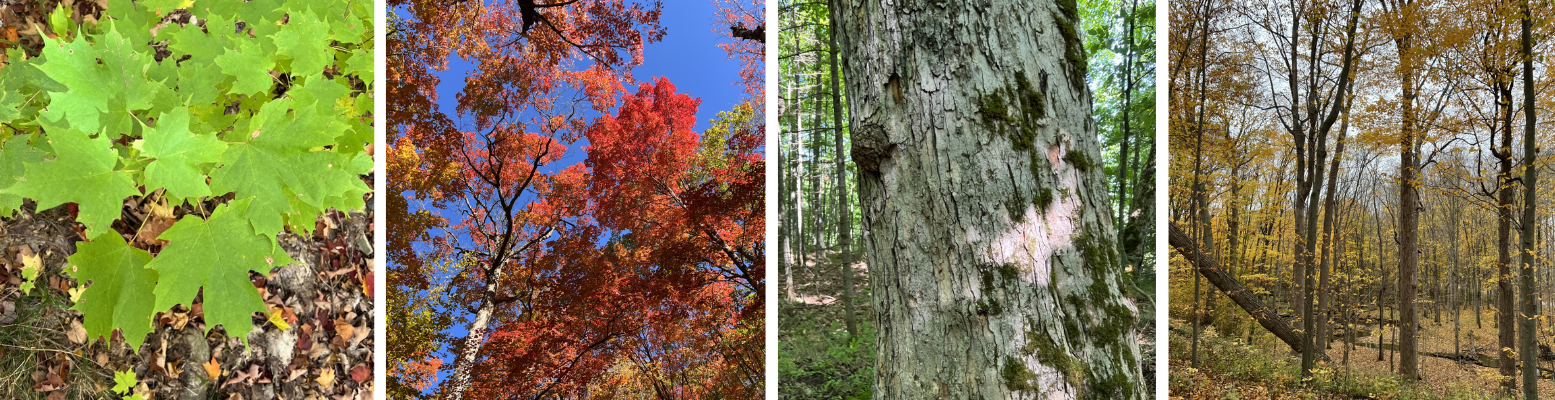
Sugar Maple is readily identified by it’s leaves, which are 8-20 cm long and almost as wide. Unlike Red and Silver Maple, Sugar Maple leaf margins have a few large teeth, rather than the more numerous teeth on the leaves of the other maple species. The leaves are vibrant green above and more washed out on the underside. In the autumn, Sugar Maple foliage transforms into a brilliant red, orange, or yellow – making it the quintessential fall colour tree. Areas with both large maple forests and substantial topographic relief, such as the Algoma Highlands, Algonquin Lake Region, and Niagara Escarpment in Grey County provide spectacular displays in October. Even the more flat Long Point Basin will not fail to impress, an autumn hike in Backus Woods, Springwater Forest, Charlotteville, or along Big Creek will surely provide vibrant colours up close. The bark of Sugar Maple is comprised of long vertical plates that curl slightly outward (but Sugar Maple bark does not usually have a shaggy appearance like Shagbark Hickory, Carya ovata, or some oaks). The twigs and buds are both brown, another important identification characteristic when compared to the reddish twigs of Silver Maple and Red Maple. Sugar Maple flowers in the spring, usually at the end of April in the Long Point Basin. The seeds are ripe after a single summer and are borne in pairs, on a winged samara (key) measuring 3-4 cm long.
The distribution of Sugar Maple is expansive, stretching from the northern shores of Lake Superior south to Missouri, Tennessee, and Virginia. However, it is much more common in the northern portions of it’s range, which encompasses the Great Lakes Region and northern Appalachians. In southern areas, it is primarily restricted to ravines and north-facing slopes with a cool microclimate. Whereas in the north, Sugar Maple often forms pure strands. But most frequently, it is found with other hardwoods. The Sugar Maple-Yellow Birch-Hemlock association is most common in the northern Great Lakes Region – though it does occur on cool slopes around Long Point. In the central and southern Great Lakes, Sugar Maple-Beech is a very important vegetation community, very common in Norfolk County. Many forests, such as Backus Woods, Jackson-Gunn Old Growth Forest, Springwater Forest, Stackhouse Forest Sanctuary, and several areas in Charlotteville have textbook examples of Sugar Maple – Beech forests. Other trees that commonly grow in Sugar Maple forests are White Ash (Fraxinus americana), Tuliptree (Liriodendron tulipifera), Bitternut Hickory (Carya cordiformis), Red Oak (Quercus rubra), Basswood (Tilia americana), Black Cherry (Prunus serotina), Butternut (Juglans cinerea), Shagbark Hickory (Carya ovata), Sassafras (Sassafras albidum), and in a few small locations across Norfolk County, Cucumber Magnolia (Magnolia accuminata). The understory of Sugar Maple forests consists largely of mesophytes – ferns, wildflowers, and shrubs that thrive in moist conditions. Sugar Maple is only infrequently found outside it’s preferred habitats – and these limitations contribute to the intricate mosaic of ecosystems throughout the Long Point Basin. Sugar Maple is rare in poorly-drained lowlands and riparian forests (though replaced by Black Maple), almost never found in oak savannas (too dry and sandy) or swamp forests, allowing other tree species to dominate these ecosystems. While Sugar Maple is a very ecologically important tree species in moist forests, the limitations on Sugar Maple’s dominance in other ecosystems have a net benefit on regional biodiversity.
Wildlife importance
Almost all parts of Sugar Maple trees are used by wildlife. The sap is consumed by Yellow-bellied Sapsuckers (Sphyrapicus varius), which extract the sap from the bark. These are also utilized by Ruby-throated Hummingbirds (Archilochus colubris) during spring migration, especially when other sources of naturally-occurring sugar are scarce in the environment. The trunk is utilized by cavity nesters, such as owls (Strigidae), woodpeckers (Picidae), and many songbirds (Passeriformes), especially forest dwellers such as the Black-capped Chickadee (Poecile atricapillus), and White-breasted Nuthatch (Sitta carolinensis). Sugar Maple is associated with dozens of lepidopteran (butterfly and moth) species, including the Rosy Maple Moth (Dryocampa rubicunda), Maple Leafcutter Moth (Paraclemensia acerifoliella), Maple Leafroller (Sparganothis acerivorana), Forest Tent Caterpillar Moth (Malacosoma disstria), and several giant silkmoths (Saturniidae), such as the Imperial Moth (Eacles imperialis), Polyphemus Moth (Antheraea polyphemus), and Cecropia Moth (Hyalophora cecropia), the largest species.
Fun facts
- Sugar Maples are extremely effective shade trees. Their dense broad canopies create a deep shade, generating a cool microclimate that benefits many understory plants and small animals.
- A stylized version of maple leaf is found on the Canadian Flag, Canadian Coat of Arms, and Ontario Coat of Arms. Some of these loosely resemble the Sugar Maple, others resemble the Red or Silver Maple.
- Sugar Maples are capable of living up to 200-300 years or more.
- As a long-lived, large deciduous tree, Sugar Maples contribute significantly to soil fertility, which increases with forest age. Their annual defoliation provides a rich source of decomposition organic matter, recycling key nutrients back into the soil.
Written by Matthew Palarchio, HBSc in Environmental Sciences, Western University.
Photos provided by Matthew Palarchio
The species you’ve just read about—and the ecosystems they depend on—need our protection. Support the work of the Long Point Basin Land Trust and help preserve the wild spaces of the Long Point Basin: https://longpointlandtrust.ca/donate
To view a directory of all species featured on our website, visit: https://longpointlandtrust.ca/featured-species

